
Every film begins with a story, but a story alone is not enough to guide a complete film production. Before actors perform the characters, cinematographers frame the scenes and editors assemble the final footage, the story must be developed into a screenplay.
Film screenwriting is the process of transforming an idea into a structured screenplay that can be developed, produced and eventually translated into moving images. It brings together story, character, conflict, dialogue, setting and visual action in a format designed specifically for cinema.
A screenplay serves as both a creative foundation and a practical production document. Directors use it to develop their visual interpretation, actors use it to understand their characters and dialogue, while production departments use it to identify locations, props, costumes, effects and other requirements.
For this reason, screenwriting is not simply about writing a good story. It is about understanding how that story will work as a film.
What Is Film Screenwriting?
Film screenwriting is the craft of writing a screenplay for a motion picture.
A screenplay describes the events, characters, dialogue and actions that make up the story while presenting them in a format suitable for film production.
Unlike a novel, a screenplay is written primarily for a visual and auditory medium. The writer must therefore communicate the story through what the audience can see and hear.
A screenplay commonly contains:
- Scene headings
- Action descriptions
- Character names
- Dialogue
- Essential performance information
- Locations and time references
- Important visual or narrative details
The screenplay should provide enough information to communicate the story clearly without attempting to control every creative decision that will eventually be made on set.
Why Is the Screenplay Important in Filmmaking?
The screenplay is one of the central foundations of a film project.
It establishes the story that the director, actors and production departments will interpret and develop throughout the filmmaking process.
The script can influence almost every major production decision, including:
- Casting
- Locations
- Production design
- Costumes
- Cinematography
- Sound
- Visual effects
- Scheduling
- Budgeting
- Post-production
A well-developed screenplay also allows producers to understand the scope of a project before significant production resources are committed.
It is therefore both a creative document and an important planning tool.
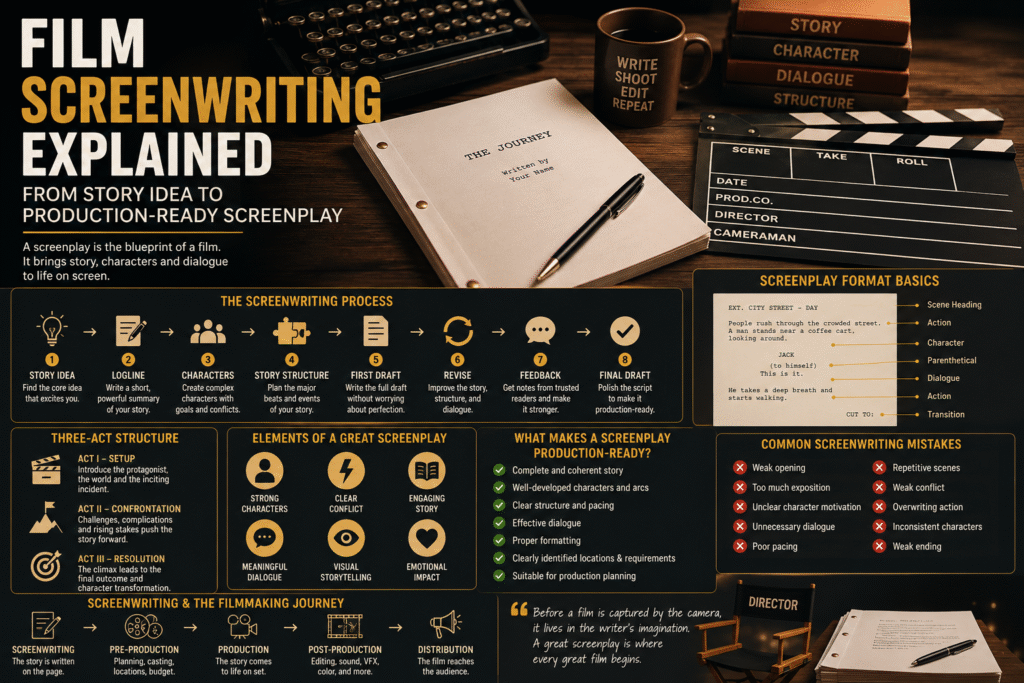
The Film Screenwriting Process
A professional screenplay normally develops through several stages. The initial idea may change considerably before the script reaches a version suitable for production.
Developing the Story Idea
The process usually begins with a central idea.
This could be a character, situation, conflict, relationship, historical event or fictional concept.
At this stage, the writer explores the fundamental questions of the story:
- Who is the story about?
- What does the protagonist want?
- What prevents them from achieving it?
- What is at stake?
- Why does the story matter?
A clear central idea gives the screenplay a foundation before the writer begins developing individual scenes.
Creating the Logline
A logline is a concise description of the central premise of the film.
It generally identifies the protagonist, the main objective or situation and the primary conflict.
A strong logline helps communicate the film quickly and can also help the writer remain focused on the central story while developing the screenplay.
Developing the Characters
Characters are at the centre of most narrative films.
The screenwriter needs to understand each significant character beyond their dialogue. Their objectives, motivations, relationships, fears, strengths and weaknesses all contribute to how they behave throughout the story.
The writer should also consider how the major characters change as the story progresses.
This development is often referred to as a character arc.
Building the Story World
The setting of a film can have a significant influence on the story.
A screenplay may take place in a contemporary city, a historical period, a rural community, a fictional world or a combination of different environments.
The writer establishes the circumstances in which the characters live and considers how the setting affects their decisions, relationships and conflicts.
Creating the Story Structure
Once the central story and characters are developed, the writer begins organising the major events.
The structure determines how information is revealed, when conflicts emerge, how tension develops and how the story reaches its conclusion.
The objective is to create a progression in which each significant event contributes to the overall narrative.
Writing the First Draft
The first complete draft transforms the planned story into an actual screenplay.
At this stage, the writer focuses on completing the narrative rather than trying to perfect every scene immediately.
The first draft often reveals problems that were not obvious during the planning stage. A character may require further development, a section may move too slowly or the ending may need restructuring.
These discoveries are a normal part of the screenwriting process.
Revising the Screenplay
Revision is one of the most important stages of professional screenwriting.
The writer reviews the screenplay to identify weaknesses in structure, character development, pacing, dialogue and continuity.
Scenes may be rewritten, removed, combined or rearranged.
A screenplay can go through multiple revisions before the writer and production team consider it ready for the next stage.
Getting Professional Feedback
Feedback can provide a perspective that the writer may not have while working closely with the script.
Depending on the project, feedback may come from a director, producer, script editor, development executive or other experienced reader.
The purpose is not simply to collect opinions. Useful feedback should help identify whether the story is clear, whether the characters are convincing and whether the screenplay is achieving its intended effect.
Preparing the Final Draft
After revisions, the screenplay is brought into a more complete form.
The final draft should have a coherent story, consistent character development, properly formatted scenes and dialogue that supports the overall narrative.
Even after this stage, changes may occur during pre-production or filming. However, the screenplay should provide a strong foundation for the production team.
Understanding Screenplay Structure
Screenplay structure refers to the organisation of the story and the sequence in which its major events unfold.
One of the most widely recognised approaches is the three-act structure.
Act I: Setup
The opening establishes the principal characters, setting and circumstances of the story.
An important event or change usually introduces the central conflict and moves the protagonist into the main narrative.
Act II: Confrontation
The second act develops the central conflict.
The protagonist faces obstacles, makes decisions and encounters consequences. Relationships may change, new information may emerge and the stakes generally become greater.
Act III: Resolution
The final act brings the central conflict toward its conclusion.
The protagonist faces the major consequences of the story and the narrative reaches its intended resolution.
The three-act structure is a useful framework, but it is not a fixed formula. Screenwriters may use many different narrative structures depending on the story and genre.
Character Development in Screenwriting
Strong character development allows audiences to understand and connect with the people at the centre of the story.
A screenwriter should establish clear motivations and meaningful conflicts for important characters.
Character Goals
What does the character want?
A clear objective gives the character’s actions direction.
Character Motivation
Why does the character want it?
Motivation provides context for their decisions.
Conflict
What prevents the character from achieving the objective?
Conflict creates dramatic tension and forces characters to make choices.
Relationships
Relationships reveal different sides of a character and can become important sources of conflict or emotional development.
Character Arc
A character arc describes how a character changes through the events of the story.
The change may be emotional, psychological, behavioural or relational.
Writing Effective Dialogue for Film
Dialogue is an important part of a screenplay, but effective screen dialogue is more than ordinary conversation written on a page.
Dialogue should have a clear dramatic purpose. It can reveal character, introduce information, create conflict, establish relationships or move the story forward.
Strong dialogue often contains subtext—the meaning beneath what a character actually says.
For example, a character may say that everything is fine while their actions clearly suggest otherwise. The contrast between dialogue and behaviour can communicate information without stating it directly.
Good dialogue should also sound appropriate for the individual character. Vocabulary, rhythm, tone and speech patterns can help distinguish one character from another.
How a Screenplay Scene Is Written
A screenplay is built from individual scenes, and each scene should contribute something meaningful to the overall story.
A typical scene includes several elements.
Scene Heading
The scene heading identifies where the scene takes place and whether it occurs inside or outside, along with the relevant time reference.
Action
Action lines describe what can be seen or heard.
They should focus on information that can be represented on screen rather than lengthy explanations of internal thoughts.
Character Name
The character’s name identifies who is speaking.
Dialogue
Dialogue records what the character says.
Parentheticals
Short parenthetical directions may occasionally be used when necessary to clarify how a line should be delivered.
They should be used sparingly.
Transitions
Transitions can indicate a change from one scene or visual moment to another when that information is useful to the screenplay.
Screenplay Format Explained
Professional screenplay formatting creates consistency and makes scripts easier for directors, actors and production departments to read.
Common formatting elements include:
- Scene headings
- Action paragraphs
- Character cues
- Dialogue
- Parentheticals
- Page numbers
- Scene transitions
Proper formatting also helps production teams estimate the approximate scale and requirements of a script.
A screenplay should therefore be clear, consistent and easy to navigate.
From Screenplay to Film Production
Once a screenplay reaches an appropriate stage of development, it becomes a major reference point during film pre-production.
The production team can analyse the script to identify:
- Characters
- Locations
- Props
- Costumes
- Vehicles
- Special effects
- Visual effects
- Stunts
- Background performers
- Day and night scenes
- Technical requirements
The assistant director and production team can use this information to develop schedules and organise the shooting plan.
At the same time, the director and cinematographer begin considering how the written scenes will be translated into images.
This is the point where the screenplay begins moving from a creative document toward a practical production blueprint.
What Is a Production-Ready Screenplay?
A production-ready screenplay is a sufficiently developed script that can serve as a reliable foundation for production planning.
It should generally contain:
- A complete and coherent story
- Clearly developed characters
- Consistent character motivations
- Structured scenes
- Refined dialogue
- Clearly identified locations
- Relevant production requirements
- Consistent screenplay formatting
Production-ready does not necessarily mean that the script can never change. Revisions may still occur during rehearsals, casting or filming.
The purpose is to ensure that the screenplay is developed enough for the production team to make informed decisions.
Screenwriting vs Storytelling
Storytelling and screenwriting are closely related, but they are not the same thing.
Storytelling is the broader process of developing and communicating a narrative.
Screenwriting is the process of writing that narrative specifically for visual and cinematic production.
A novel can spend several pages exploring a character’s internal thoughts. A screenplay generally needs to communicate those thoughts through behaviour, dialogue, visual action or other cinematic elements.
This difference makes screenwriting a specialised form of storytelling.
Collaboration Between Screenwriters, Directors and Producers
Professional screenwriting is often a collaborative process.
The screenwriter develops the story, while the director may shape the screenplay according to a particular creative vision. Producers may also provide feedback based on budget, production requirements, audience expectations and the overall direction of the project.
This collaboration can result in additional drafts and rewrites.
A screenplay may therefore evolve as the project moves closer to production.
The objective is to preserve the central creative idea while making the screenplay stronger, clearer and more practical to produce.
Screenwriting and Film Pre-Production
The screenplay becomes particularly important once film pre-production begins.
Casting teams use the script to understand the characters. Location teams identify the settings required for each scene. Production designers examine the environments, props and visual requirements, while the assistant director’s team analyses the script for scheduling and logistical purposes.
Budgeting is also closely connected to the screenplay.
A script involving multiple locations, large crowds, complex stunts or extensive visual effects will naturally have different production requirements from a story set primarily in a small number of locations.
For this reason, screenplay development and pre-production are closely connected.
Common Screenwriting Mistakes
Even a strong story concept can lose its impact when the screenplay lacks focus or structure.
Weak Opening
The opening should establish the story’s world and give the audience a reason to continue watching.
Excessive Exposition
Information should be introduced naturally through character behaviour, dialogue and events rather than through unnecessary explanation.
Unclear Character Motivation
Major character decisions should feel understandable within the context of the story.
Unnecessary Dialogue
Dialogue should contribute to character, conflict, information or progression.
Poor Pacing
Scenes should have an appropriate rhythm and should not remain longer than necessary.
Repetitive Scenes
Scenes that perform the same narrative function may weaken the overall structure.
Weak Conflict
Without meaningful obstacles, characters have little reason to change or act.
Overwritten Action
Screenplay action should remain focused on what is relevant to the cinematic experience.
Inconsistent Character Behaviour
Character decisions should remain believable within the established story and development.
Unsatisfying Ending
The conclusion should address the central dramatic questions and provide an appropriate resolution.
Screenwriting Software and Production Tools
Modern screenwriters use specialised software to manage screenplay formatting and revisions.
Common features include:
- Automatic screenplay formatting
- Scene organisation
- Character tracking
- Revision management
- Collaboration
- Version control
- PDF and production exports
These tools can make the writing process more efficient, but software does not replace the creative work involved in developing a strong screenplay.
The quality of the story, structure, characters and writing remains the responsibility of the screenwriter.
Final Thoughts
Film screenwriting is where a film’s creative vision begins to take a structured form.
A screenplay establishes the characters, conflict, scenes and dialogue that will eventually be interpreted by directors, actors, cinematographers, designers, editors and other members of the filmmaking team.
The process extends far beyond writing a first draft. Story development, character creation, structural planning, dialogue, revision and collaboration all contribute to the development of a production-ready screenplay.
A strong screenplay gives a film production something essential: a clear creative foundation from which every department can begin its work.
Before a film is photographed, edited and presented to an audience, its story first has to work on the page.
Primary Keywords
- film screenwriting
- screenplay writing
- film screenplay
- movie screenplay
- screenwriting process
- screenplay structure
- screenplay writing process
- writing a film script
Secondary Keywords
- how to write a screenplay
- how movies are written
- screenplay format
- film script writing
- screenplay development
- screenwriter
- screenplay scenes
- screenplay dialogue
- film story development
- screenplay structure
- script development
Long-Tail Keywords
- what is film screenwriting
- how to write a screenplay for a movie
- how does the screenwriting process work
- how a story becomes a screenplay
- how to structure a film screenplay
- what should be included in a screenplay
- how screenwriters develop movie characters
- how to write dialogue for a screenplay
- what is a production-ready screenplay
- how filmmakers develop a movie script