
Introduction
A film begins with an idea, a screenplay and a creative vision, but turning that vision into a finished production requires financial resources. From hiring the cast and crew to securing locations, renting equipment and completing post-production, almost every stage of filmmaking involves costs.
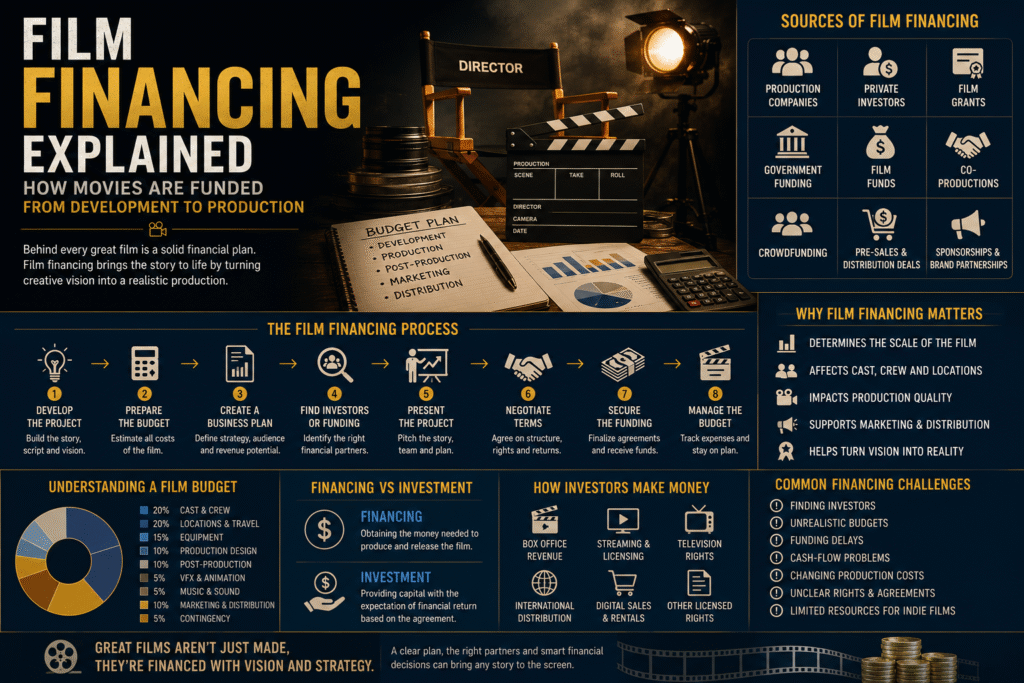
Film financing is the process of securing and managing the money required to develop, produce, complete and sometimes market a film. Depending on the project, funding may come from production companies, private investors, government programmes, film grants, co-production partners, crowdfunding campaigns or distribution arrangements.
The financing structure of a film can vary greatly depending on its budget, genre, production company, target audience and distribution plans. A large commercial production may have several financial partners, while an independent filmmaker may combine personal investment, grants and private funding to complete a project.
Understanding how film financing works is therefore important for producers and filmmakers who want to turn a screenplay into a realistic production.
What Is Film Financing?
Film financing refers to the process of raising and organising the money needed to make and release a movie.
The funding may be required at different stages of the filmmaking process, including development, production, post-production, marketing and distribution.
A film’s financial plan generally considers:
- Development expenses
- Production costs
- Cast and crew payments
- Equipment and locations
- Production design
- Post-production
- Visual effects
- Music and sound
- Marketing
- Distribution
- Contingency expenses
The amount of financing required depends on the scale and requirements of the individual project.
Why Is Film Financing Important?
A strong financial plan gives a production a realistic foundation.
Without adequate funding, filmmakers may face delays, reduced production quality or difficulty completing the project.
Film financing can influence:
- The size of the production
- The number of shooting days
- Cast and crew requirements
- Location choices
- Equipment
- Production design
- Post-production resources
- Visual effects
- Marketing activities
- Distribution opportunities
Financing does not determine the creative quality of a film on its own, but it provides the resources required to execute the creative plan.
How the Film Financing Process Works
Film financing usually begins with a producer developing a financial plan around the proposed project.
Developing the Film Project
Before approaching potential financiers, producers normally develop the basic project.
This may include the screenplay, story concept, director’s vision, preliminary cast ideas and production approach.
A clear project gives potential funding partners something concrete to evaluate.
Preparing the Production Budget
The producer and production team prepare an estimated budget covering the expected costs of making the film.
The budget may include cast, crew, equipment, locations, travel, accommodation, insurance, post-production and other expenses.
A realistic budget is important because potential financiers need to understand how much money the project requires.
Creating a Business Plan
A film financing plan goes beyond simply stating the production budget.
Producers may also need to explain the intended audience, distribution strategy, revenue opportunities and overall commercial approach.
This helps potential investors understand how the project is expected to operate as a business.
Finding Potential Investors or Funding Sources
Once the project and financial plan are prepared, producers can identify suitable funding sources.
These may include production companies, private investors, film funds, grants, co-production partners and other financing organisations.
The most suitable source depends on the film and the filmmaker’s circumstances.
Presenting the Film Project
Producers may present the project through a pitch package containing information such as the screenplay, synopsis, budget, production plan, director’s vision and financial structure.
The purpose is to communicate both the creative potential and practical requirements of the project.
Negotiating Financing Terms
If a funding partner is interested, the parties discuss the terms of the arrangement.
These may cover the amount of funding, ownership, rights, revenue participation, repayment, credits and other responsibilities.
The terms should be clearly documented before funding is committed.
Securing the Funding
Once the necessary agreements are completed, the financing can be formally secured.
Depending on the project, funding may arrive in stages rather than as a single payment.
Managing the Production Budget
Securing funding is only one part of film finance.
The production team must also monitor expenses throughout production to ensure that the project remains within its approved budget.
Careful financial management can help reduce unexpected problems later in production.
Main Sources of Film Financing
Filmmakers can use different sources of funding depending on the scale and nature of their project.
Production Companies
Production companies may finance projects directly or bring together different funding partners.
They can also contribute development resources, production expertise and industry relationships.
Private Investors
Private investors may provide capital for a film with the expectation of receiving a financial return according to the investment agreement.
The terms can vary considerably between projects.
Film Grants
Film grants can provide financial support to filmmakers and production companies.
Some grants focus on development, while others support production, post-production or projects with particular cultural or artistic objectives.
Government Funding
Some governments and public organisations provide funding programmes designed to support film production and the local screen industry.
Eligibility and application requirements vary by country and programme.
Film Funds
Dedicated film funds may provide financing to qualifying projects.
These funds can have specific criteria relating to the production’s location, creative team, budget, subject matter or economic impact.
Co-Productions
A co-production involves two or more production partners working together on a film.
Each partner may contribute financing, production resources, expertise or access to particular markets.
Crowdfunding
Crowdfunding allows filmmakers to raise money directly from supporters and audiences.
Campaigns can use online platforms to present the project, explain the funding goal and encourage people to contribute.
Pre-Sales and Distribution Deals
In some cases, distribution arrangements can contribute to the financing structure of a film.
A distributor or buyer may agree to acquire certain rights under specific terms, potentially providing financial support for the production.
These arrangements depend heavily on the project and the parties involved.
Brand Partnerships and Sponsorships
Some productions work with brands or commercial partners that provide financial or other support.
The arrangement may involve promotional partnerships, product placement or sponsorship, depending on the project.
How Independent Films Are Financed
Independent films often have smaller budgets and fewer financial resources than major studio productions.
As a result, independent filmmakers may combine several funding sources rather than depending on one financier.
A project might use a combination such as:
Personal Investment + Film Grant + Private Investment + Crowdfunding + Co-Production
The exact structure depends on the project.
Independent filmmakers may also use film festivals, industry events, pitch programmes and professional networks to identify potential funding opportunities.
The most important part is creating a realistic financial plan that matches the scale of the film.
Understanding a Film Production Budget
A film budget provides an estimate of how much money is required to complete the production.
Common budget categories include:
Development
Costs associated with developing the screenplay and preparing the project.
Cast and Crew
Payments for actors, directors, cinematographers, production staff and other crew members.
Equipment
Camera equipment, lighting, sound equipment and other production resources.
Locations
Location fees, permits, transportation and related expenses.
Production Design
Sets, props, costumes, decorations and other visual elements.
Travel and Accommodation
Transportation, accommodation and related costs when filming requires the cast and crew to travel.
Insurance
Production insurance and other necessary forms of coverage.
Post-Production
Editing, colour grading, sound mixing, music, visual effects and other finishing work.
Marketing and Distribution
Promotional campaigns, advertising, delivery materials and distribution-related expenses.
Contingency
A contingency amount can help a production handle unexpected costs that arise during filmmaking.
Film Financing vs Film Investment
The terms film financing and film investment are related, but they do not mean exactly the same thing.
Film financing refers broadly to the process of obtaining the money required to develop, produce and release a film.
Film investment generally refers to capital provided by an investor with an expectation of a financial return according to the agreed terms.
Not all film financing is investment. Grants, public funding and some forms of sponsorship may support a film without operating as conventional investments.
Understanding this distinction can help filmmakers explain their financial structure more clearly.
How Film Investors Make Money
Film investors may receive returns through different sources depending on the financing agreement.
Potential revenue sources can include:
- Box office revenue
- Streaming licensing
- Television rights
- Digital sales
- Digital rentals
- International distribution
- Other licensed rights
However, film investment carries financial risk. A movie may not recover its production and distribution costs, and returns are never guaranteed.
The exact financial arrangement should always be defined in the relevant investment or production agreements.
Film Grants and Government Funding
Grants and public funding can be important sources of support for filmmakers, particularly for independent and culturally significant projects.
Funding programmes may support:
- Script development
- Production
- Post-production
- Documentary projects
- Regional cinema
- Emerging filmmakers
- Cultural projects
Applications often require detailed information about the film, creative team, budget and production plan.
Because every funding programme has different rules, filmmakers should carefully review eligibility requirements before applying.
Crowdfunding for Films
Crowdfunding has created another way for filmmakers to raise money directly from audiences and supporters.
A successful crowdfunding campaign usually requires more than simply asking people for money.
Filmmakers need to communicate:
- What the film is about
- Why the project matters
- How much funding is required
- How the money will be used
- What supporters can expect
A campaign may include a promotional video, project images, filmmaker messages, social media promotion and regular updates.
Crowdfunding can also serve a second purpose: building an early audience around the film.
Film Co-Production and International Financing
Film co-production allows multiple production partners to collaborate on a project.
An international co-production may involve companies from different countries contributing financing, talent, production resources or distribution opportunities.
Co-productions can help filmmakers access additional resources and international markets.
However, they can also involve more complex agreements concerning financing, ownership, rights, production responsibilities and distribution territories.
Film Financing and Distribution
Film financing and distribution are closely connected.
Before committing money to a project, producers and investors may consider how the finished film could reach its intended audience.
A film’s genre, target audience, commercial potential and distribution strategy can influence how the project is presented to potential financiers.
This is why film distribution should not always be considered only after production has finished. Thinking about the audience and release strategy during development can help create a more realistic financial plan.
Film Financing and Film Festivals
Film festivals can also form part of a film’s wider financing and career strategy.
A successful festival run can provide recognition, reviews, industry exposure and opportunities to build professional relationships.
For emerging filmmakers, these opportunities can help strengthen their professional profile and may support future projects.
However, festival selection does not guarantee financing, distribution or commercial success.
Festivals should therefore be considered one part of a broader filmmaking strategy.
Common Film Financing Challenges
Raising money for a film can be difficult, particularly for independent productions.
Finding Investors
Finding people willing to finance a film can take considerable time and networking.
Unrealistic Budgets
A budget that does not accurately reflect production requirements can create financial problems later.
Incomplete Financial Planning
Producers need to consider more than the cost of shooting. Post-production, marketing, distribution and contingency costs also need to be considered.
Unclear Rights
Ownership and rights should be clearly established before financing agreements are completed.
Changing Production Costs
Locations, equipment, travel and other costs can change during production.
Funding Delays
If financing does not arrive according to the production schedule, filming may be delayed.
Cash-Flow Problems
Even when a production has secured funding, the timing of payments and expenses needs to be carefully managed.
Limited Independent-Film Resources
Independent filmmakers may have fewer financing options and less access to established industry networks.
How to Prepare a Film Financing Proposal
A professional financing proposal should give potential funding partners a clear understanding of both the film and its financial requirements.
Depending on the project, it may include:
- Logline
- Synopsis
- Screenplay
- Director’s statement
- Producer’s statement
- Production budget
- Financing plan
- Production schedule
- Cast and crew information
- Audience profile
- Distribution strategy
- Revenue projections
The proposal should be realistic and supported by clear information rather than relying only on enthusiasm for the project.
Common Mistakes Filmmakers Make When Seeking Funding
Approaching Investors Without a Clear Budget
Investors need to understand how much money is required and how it will be used.
Overestimating Commercial Potential
A film should be presented realistically. Promising guaranteed profits can damage credibility.
Having an Incomplete Financing Plan
Relying on a single funding source can leave a project vulnerable if that source becomes unavailable.
Not Understanding Rights
Filmmakers should know who owns the project and what rights are being offered to financing partners.
Ignoring Contingency Costs
Unexpected expenses are common in film production, so financial planning should account for them.
Failing to Explain the Audience
A financing proposal should make it clear who the film is intended for and why that audience may be interested.
Not Preparing Professional Documentation
A strong screenplay should be supported by a clear budget, production plan and financing proposal.
Final Thoughts
Film financing is one of the foundations of a successful production. A strong story and talented creative team are important, but a film also needs a realistic financial structure that allows the production to move from development to completion.
There is no single way to finance a movie. Large productions may involve multiple investors and production partners, while independent filmmakers may combine grants, crowdfunding, private investment and co-production arrangements.
The most effective approach is to build a financing plan that matches the film’s creative ambitions, production requirements and intended audience.
Ultimately, film financing is not simply about finding money. It is about creating a practical structure that gives filmmakers the resources to make the film while clearly defining the responsibilities, rights and expectations of everyone involved.
Primary Keywords
- film financing
- film funding
- movie financing
- movie funding
- film finance
- film financing process
- independent film financing
- film production financing
Secondary Keywords
- film financing companies
- film investors
- movie investors
- film production budget
- film funding sources
- film financing strategy
- film investment
- film grants
- film crowdfunding
- film co-production
- production company financing
- independent movie funding
Long-Tail Keywords
- what is film financing
- how are movies financed
- how do filmmakers fund a movie
- how to finance an independent film
- where does movie funding come from
- how film production is financed
- different sources of film financing
- how film investors make money
- how film crowdfunding works
- how independent filmmakers raise money
- film financing process step by step