
Film editing is the process of selecting, arranging and refining recorded footage to create the final cinematic experience. It determines how scenes connect, how quickly the story moves, when information is revealed and how audiences experience the emotions of the film.
The editor works closely with the director and other post-production departments to transform raw footage into a structured sequence. Through picture editing, sound, music, visual effects and colour work, the individual pieces of footage gradually become a finished movie.
What Is Film Editing?
Film editing is the process of selecting and arranging recorded footage into a continuous visual narrative.
A film editor reviews the material captured during production and decides which takes, shots and performances should be used in the final film.
Editing can involve:
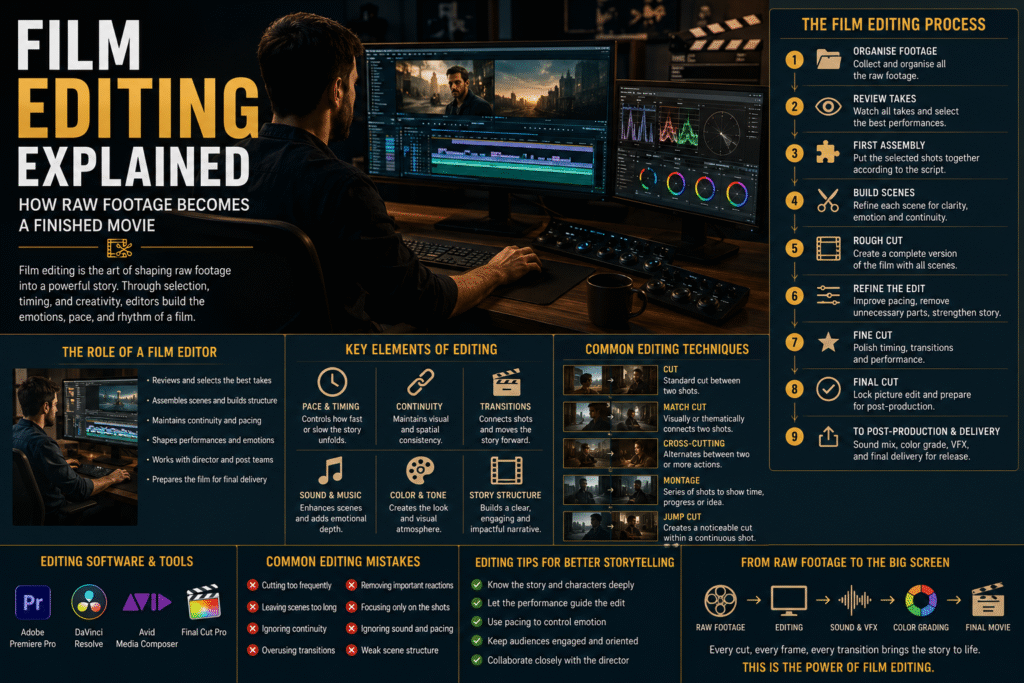
- Selecting the best takes
- Arranging shots
- Building scenes
- Maintaining continuity
- Controlling pacing
- Creating transitions
- Shaping performances
- Managing visual effects
- Working with sound and music
- Preparing the final picture
The editor’s work is not simply about cutting unwanted footage. It is about creating meaning, rhythm and structure from the material that was captured during production.
Why Is Film Editing Important?
Editing has a major influence on how audiences experience a film.
The same footage can create very different emotional effects depending on how it is arranged.
Film editing can determine:
- The pace of a scene
- The timing of a joke
- The intensity of a dramatic moment
- The suspense of a sequence
- The emotional impact of a performance
- How information is revealed
- How different locations are connected
- How the overall story flows
A strong edit can make a film feel natural and engaging, while poor editing can make even well-shot material feel confusing or slow.
The Film Editing Process
The editing process normally develops through several stages rather than being completed in one pass.
Organising the Footage
After filming, the editor receives the recorded material.
The footage is organised according to scenes, takes, camera angles and other production information.
Good organisation is important because large productions can generate a significant amount of material.
Reviewing the Takes
The editor reviews the available takes to understand the performances and visual options.
Different takes may contain different performances, camera movements or technical qualities.
The editor identifies the material that has the greatest potential for the final sequence.
Creating the First Assembly
The selected footage is initially assembled according to the screenplay and production plan.
At this stage, the objective is to create a complete version of the story rather than achieve the final pacing.
The first assembly can reveal problems with scene length, structure or continuity.
Building Individual Scenes
The editor then works more closely on individual scenes.
Shots are arranged to create a logical progression while maintaining the intended performance and story.
The editor considers when to cut from one shot to another and which reactions or details are necessary.
Creating the Rough Cut
The rough cut provides a more complete representation of the film.
The structure becomes clearer, but scenes may still be longer than necessary and some sections may require substantial revision.
The director and editor can review the rough cut together and identify areas that need improvement.
Refining the Edit
During refinement, unnecessary material is removed and the pacing of each scene is improved.
The editor may shorten pauses, change the order of shots, combine performances or restructure scenes.
This stage can significantly change the way the film feels.
Creating the Fine Cut
The fine cut is a much more polished version of the film.
The timing of individual cuts is carefully adjusted and the relationship between scenes is refined.
At this point, the overall structure and pacing are much closer to the intended final version.
Preparing the Final Cut
Once the picture edit is approved, the film can move toward final post-production.
The final version may then be prepared for:
- Sound mixing
- Music
- Visual effects
- Colour grading
- Titles
- Subtitles
- Distribution masters
The Role of a Film Editor
A film editor is responsible for shaping recorded footage into a coherent cinematic experience.
The editor works with the director to determine how the story should unfold through the available footage.
Their responsibilities can include:
- Reviewing footage
- Selecting takes
- Building scenes
- Managing continuity
- Controlling pacing
- Refining performances
- Structuring sequences
- Coordinating with post-production teams
- Preparing different versions of the edit
The editor also brings an independent perspective to the material.
Because the editor works extensively with the footage after filming, they can identify opportunities to strengthen the story that may not have been obvious during production.
How Film Editors Work With Directors
The relationship between the editor and director is an important part of post-production.
The director has the overall creative vision for the film, while the editor contributes specialised knowledge of rhythm, structure and visual storytelling.
Together, they may discuss:
- Story structure
- Character development
- Scene length
- Performance choices
- Pacing
- Transitions
- Emotional impact
- Overall tone
The editing room can therefore become an important creative space where the final form of the film is discovered.
Understanding Film Pacing and Rhythm
Pacing refers to the speed at which a film’s story and individual scenes progress.
A fast-paced sequence may use shorter shots and rapid transitions, while a dramatic or emotional scene may allow shots to remain on screen longer.
Pacing depends on more than the number of cuts.
Editors also consider:
- Performance
- Dialogue
- Music
- Sound
- Camera movement
- Scene structure
- Character reactions
The objective is not always to make a film faster. Good pacing means giving each moment the amount of time required to achieve its intended effect.
Continuity Editing Explained
Continuity editing aims to create a smooth and understandable visual experience.
The audience should generally be able to understand where characters are, what they are doing and how different shots relate to one another.
Editors consider details such as:
- Character positions
- Screen direction
- Eyelines
- Props
- Costume
- Movement
- Time
- Location
Continuity helps prevent unnecessary visual confusion and allows the audience to remain focused on the story.
How Sound and Music Influence Film Editing
Picture editing does not work independently from sound.
Dialogue, sound effects, ambience and music can significantly affect the timing and emotional impact of a scene.
For example, an editor may adjust the timing of a visual cut to work more effectively with a musical cue or sound effect.
Sound can also allow an editor to transition between scenes smoothly.
This is why picture editing and sound post-production are closely connected.
Film Editing and Visual Effects
Visual effects are often integrated into the editing process.
Editors may initially work with temporary effects or placeholder elements before the final visual effects are completed.
The edit establishes the timing and structure of sequences so that visual effects artists know exactly where their work needs to appear.
After the final effects are completed, the shots are integrated into the final picture.
Colour Grading and the Final Picture
After the picture edit is locked, the film can move into colour grading.
Colour grading helps create consistency between shots and establish the visual character of the film.
The colourist may adjust:
- Exposure
- Contrast
- Colour balance
- Skin tones
- Highlights
- Shadows
- Overall visual tone
The final colour treatment works together with the edit, cinematography, production design and lighting to create the visual identity of the finished film.
Common Film Editing Techniques
Editors use many techniques to control storytelling and audience attention.
Straight Cut
A straightforward transition from one shot to another.
Match Cut
A cut that connects two visually or conceptually related shots.
Cross-Cutting
Moving between two or more scenes or actions to suggest that they are happening in relation to each other.
Montage
A sequence of shots edited together to communicate the passage of time, development or an idea.
Jump Cut
A noticeable cut within a continuous scene that creates a deliberate interruption in time or movement.
Cutaway
A shot that moves away from the primary action to show another relevant detail.
Reaction Shot
A shot showing a character’s response to an event, statement or action.
Each technique can serve a different storytelling purpose.
Film Editing vs Video Editing
Film editing and video editing share many fundamental principles, including cutting footage, arranging scenes, working with sound and controlling pacing.
The main difference often lies in the scale, workflow and production context.
Feature films and large productions may involve:
- Large volumes of footage
- Multiple editing stages
- Dedicated editorial teams
- Extensive sound work
- Visual effects
- Colour grading
- Multiple review processes
The fundamental objective remains the same: shaping recorded material into an effective visual story.
Common Film Editing Mistakes
Even strong footage can lose its impact through ineffective editing.
Cutting Too Frequently
Constant cuts can make a scene feel unnecessarily rushed.
Leaving Scenes Too Long
A scene that continues after its dramatic purpose has been achieved can weaken the overall pacing.
Ignoring Continuity
Unexplained changes in position, props or movement can distract viewers.
Overusing Transitions
Transitions should serve a purpose rather than being added simply for visual effect.
Removing Important Reactions
Character reactions can provide important emotional information.
Focusing Only on Individual Shots
An excellent individual shot may not work well if it damages the rhythm or structure of the complete scene.
Ignoring Sound
Picture and sound work together. Editing without considering sound can make scenes feel incomplete.
How Long Does It Take to Edit a Movie?
There is no fixed editing timeline for every film.
The duration can depend on:
- Film length
- Amount of footage
- Number of shooting days
- Complexity of the story
- Visual effects
- Number of revisions
- Director’s approach
- Post-production schedule
A simple production may move through editing relatively quickly, while a large feature involving extensive visual effects and multiple rounds of revisions can take considerably longer.
Editing is therefore planned as part of the wider post-production schedule.
Film Editing Software and Technology
Modern film editors use specialised digital editing systems to organise, review and manipulate footage.
Professional editing workflows can include features such as:
- Non-linear editing
- Multi-camera editing
- Audio synchronisation
- Colour management
- Visual effects integration
- Media organisation
- Version control
- Collaborative editing
- High-resolution workflows
Technology continues to make editing more efficient, but creative judgement remains at the centre of the process.
From Final Cut to Distribution
Once the picture edit is approved and the remaining post-production work is completed, the finished film can be prepared for release.
This may include:
- Final sound mix
- Colour grading
- Visual effects
- Titles
- Subtitles
- Captions
- Mastering
- Quality control
- Delivery formats
The completed materials can then be prepared for film distribution through cinemas, streaming platforms, television networks, digital services or other release channels.
Final Thoughts
Film editing is where recorded footage becomes a finished cinematic story.
The editor takes individual shots, performances and scenes and determines how they should work together. Through selection, timing, pacing and structure, editing can influence the emotion, clarity and rhythm of an entire film.
The process extends beyond simply removing unwanted footage. It involves understanding performances, maintaining continuity, shaping scenes, collaborating with the director and preparing the picture for sound, visual effects, colour grading and final delivery.
A film may begin with a screenplay and come to life during production, but editing is where those elements are shaped into the version that audiences ultimately experience.
Primary Keywords
- film editing
- movie editing
- film editor
- video editing for films
- film editing process
- movie editing process
- post-production editing
- film editing techniques
Secondary Keywords
- raw footage
- editing a movie
- film editor role
- film editing workflow
- assembling film footage
- scene editing
- continuity editing
- film pacing
- editing room
- picture editing
- final cut
- film post-production
Internal Links
Film Distribution — https://enigmacelluloid.com/
Film Screenwriting — https://enigmacelluloid.com/how-screenwriters-turn-ideas-into-blockbuster-movies/
Sound & Music in Film — https://enigmacelluloid.com/sound-music-in-film/
Film Production — https://enigmacelluloid.com/
Film Post-Production — https://enigmacelluloid.com/
Ad Film Production — https://enigmacelluloid.com/ad-film-production/
External Links
- Adobe Film Editing — https://www.adobe.com/in/products/premiere/movie-and-film-editing.html
- Adobe Post-Production Guide — https://www.adobe.com/in/creativecloud/video/discover/post-production.html
- Adobe Video Editing Basics — https://www.adobe.com/in/creativecloud/video/discover/edit-a-video.html
- Adobe Film & TV Production Best Practices — https://helpx.adobe.com/in/premiere/desktop/get-started/preferences-and-settings/best-practices.html