
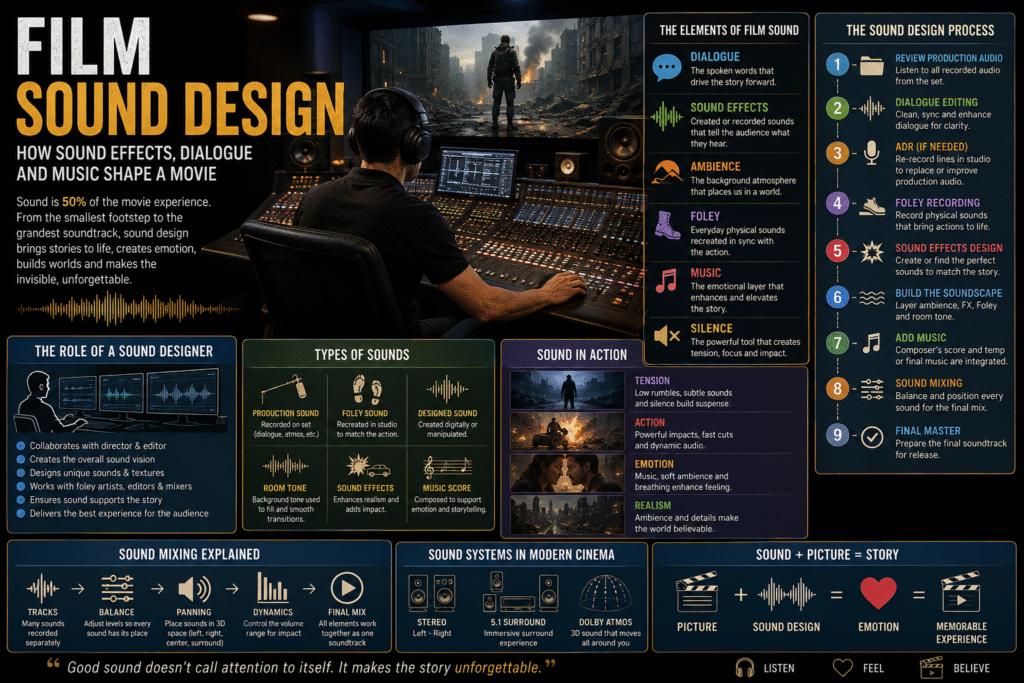
Film sound design is the creative and technical process of developing the complete soundscape of a movie. It involves recording, editing, creating and arranging different layers of sound so they work together with the visuals and story.
From the footsteps of a character walking through a corridor to the atmosphere of a busy city, the sound of an approaching vehicle or the music accompanying an emotional moment, every sound can contribute to the cinematic experience.
Sound design begins with the audio captured during production and continues through post-production, where dialogue is refined, additional sounds are created, music is integrated and the final soundtrack is mixed.
What Is Film Sound Design?
Film sound design is the process of creating, selecting, recording, editing and combining sounds for a movie.
The objective is to build an audio environment that supports the story and complements the images on screen.
Film sound design can include:
- Dialogue
- Sound effects
- Foley
- Ambient sound
- Production sound
- Music
- Room tone
- Silence
- Special sound effects
- Final sound mixing
A sound designer may use original recordings, library sounds, Foley performances, digitally created sounds and processed audio to create the required soundscape.
The work is both creative and technical because the sounds need to fit the story while also meeting the technical requirements of the final production.
Why Is Sound Important in Film?
Sound can influence how audiences interpret a scene without them consciously noticing every individual element.
A visual scene can feel completely different when the sound changes.
Sound can help establish:
- Mood
- Atmosphere
- Tension
- Emotion
- Location
- Character perspective
- Time and environment
- Narrative information
For example, a quiet scene can become tense through subtle background sounds, while music can make the same sequence feel emotional or uplifting.
Good sound design supports the visual storytelling without distracting the audience from the story.
The Main Elements of Film Sound
A finished film soundtrack is usually made up of several different layers.
Dialogue
Dialogue contains the spoken words of the characters.
It is usually one of the most important elements because it communicates information, personality, relationships and dramatic conflict.
Dialogue may require editing, noise reduction, synchronisation and additional recording during post-production.
Sound Effects
Sound effects represent actions and events within the film.
Examples include:
- Vehicles
- Doors
- Weapons
- Footsteps
- Weather
- Machinery
- Phones
- Explosions
- Crowd sounds
Some effects are recorded during production, while others are added during post-production.
Ambient Sound
Ambient sound establishes the environment surrounding the characters.
A scene set in a city may include traffic, distant conversations and vehicles. A forest scene may contain wind, birds and insects.
These sounds help make locations feel believable.
Foley
Foley is the process of recording or recreating everyday sounds in synchronisation with the action on screen.
Foley artists may recreate:
- Footsteps
- Clothing movement
- Object handling
- Doors opening
- Eating
- Physical movement
These sounds are often subtle, but they can make performances and environments feel much more realistic.
Music
Music can influence the emotional direction of a scene.
A film score can create tension, excitement, sadness, anticipation or warmth.
Music can also establish themes associated with particular characters, places or ideas.
Silence
Silence is also a sound-design decision.
Removing or reducing sound at the right moment can create tension, focus attention on a character or make an emotional moment more powerful.
Silence can therefore be just as important as adding sound.
The Film Sound Design Process
Sound design develops through several stages during production and post-production.
Reviewing Production Audio
The sound team begins by reviewing the audio recorded during filming.
This includes dialogue, room tone, environmental sound and other production recordings.
The team identifies usable material and determines where additional sound work will be required.
Dialogue Editing
Production dialogue may contain unwanted background noise, microphone issues or inconsistencies between different takes.
Dialogue editors clean and organise the recordings while preserving the natural performance.
Recording Additional Dialogue
Sometimes the original production recording cannot be used effectively.
In such cases, actors may return to a recording studio to perform dialogue again.
This process is commonly known as Automated Dialogue Replacement (ADR).
ADR can be used when dialogue needs to be replaced because of background noise, technical problems or creative changes.
Creating Foley
Foley artists recreate physical sounds while watching the footage.
They synchronise their movements with the actors’ actions to produce realistic footsteps, clothing sounds and object interactions.
Designing Sound Effects
Sound designers may create or select sounds that do not exist in the original recording.
A science-fiction film, for example, may require entirely artificial sounds for futuristic technology or imaginary creatures.
These sounds can be recorded, edited, layered or digitally manipulated.
Building the Soundscape
Individual sounds are then combined to create the environment of each scene.
The sound team decides which elements should be prominent and which should remain subtle.
The objective is to create a balanced soundscape that supports the story.
Adding Music
The score and other musical elements are integrated into the soundtrack.
Music needs to work with dialogue and effects rather than overpower them.
The timing of musical cues can also influence the emotional impact of individual scenes.
Sound Mixing
During sound mixing, different audio elements are balanced and positioned to create the final soundtrack.
The mixer considers dialogue, effects, ambience and music together.
Volume, dynamics, spatial placement and transitions are carefully adjusted.
Final Audio Mastering
Once the soundtrack has been approved, the final audio is prepared according to the technical requirements of the intended release.
Different delivery formats may have specific audio requirements for cinema, streaming, television and other platforms.
What Does a Film Sound Designer Do?
A film sound designer helps develop the overall sonic identity of a movie.
Depending on the production, the sound designer may collaborate with:
- Director
- Sound editor
- Dialogue editor
- Foley artists
- Re-recording mixers
- Composer
- Production sound team
- Visual effects team
The sound designer considers how individual sounds can support the director’s creative vision.
The role can range from designing individual effects to helping establish the overall atmosphere and sonic style of the film.
Production Sound vs Post-Production Sound
There are two important stages of sound work in filmmaking.
Production Sound
Production sound is recorded while the film is being shot.
It usually includes dialogue, room tone and environmental sounds captured on set.
The production sound team focuses on obtaining clean and usable recordings while filming.
Post-Production Sound
Post-production sound takes place after filming.
It can involve:
- Dialogue editing
- ADR
- Foley
- Sound effects
- Ambient sound
- Music
- Sound design
- Mixing
- Mastering
Post-production allows filmmakers to refine and expand the soundtrack beyond what was captured on set.
How Foley Sound Is Created for Movies
Foley is one of the most interesting parts of film sound production.
A Foley artist watches the scene and physically recreates sounds in synchronisation with the action.
For example, footsteps may be recorded on different surfaces to match the location shown on screen.
Other everyday sounds may also be recreated using unexpected objects.
The goal is not necessarily to reproduce exactly what happened during filming. The objective is to create a sound that feels natural and convincing when combined with the image.
How Sound Effects Create Emotion and Atmosphere
Sound effects can change the emotional character of a scene.
A distant sound may suggest danger before the audience sees its source. A sudden impact can create shock, while a low background rumble can increase tension.
Sound can also guide attention.
By making one element louder or clearer than others, the sound team can encourage the audience to focus on a particular event.
This makes sound design an important storytelling tool rather than simply a technical finishing stage.
The Role of Dialogue in Film
Dialogue communicates information, but its role extends beyond spoken words.
The recording quality, timing, performance and surrounding sounds can all affect how dialogue is experienced.
Sound teams may need to ensure that:
- Dialogue remains clear
- Background noise is controlled
- Different takes sound consistent
- Room ambience matches between shots
- ADR blends naturally with production recordings
The goal is to preserve the performance while ensuring that audiences can understand what the characters are saying.
How Music Works With Film Sound Design
Music and sound effects need to work together rather than compete with each other.
A composer may create a score that supports the emotional direction of a scene, while the sound designer builds the surrounding environment.
The combination can create a much stronger effect than either element alone.
Music can also provide transitions between scenes, reinforce character themes and create emotional expectations.
The Importance of Silence in Film
Silence can be a deliberate creative choice.
Removing background sound before an important moment can make the audience more aware of what follows.
A sudden reduction in sound may create:
- Suspense
- Isolation
- Emotional focus
- Shock
- Anticipation
Silence is therefore not simply the absence of sound. It can be an active part of the storytelling strategy.
Film Sound Mixing Explained
Sound mixing brings the different elements of the soundtrack together.
The mixer balances:
- Dialogue
- Music
- Sound effects
- Foley
- Ambience
- Special effects
The relative volume of each element can change throughout a scene.
The mixer also considers spatial placement and the acoustic environment so that the soundtrack works correctly in the intended playback format.
Surround Sound and Modern Cinema Audio
Modern cinema sound systems can create a sense of space by positioning audio around the audience.
Sounds can be placed across different channels to create a more immersive experience.
For example, environmental sounds may surround the audience while dialogue remains focused toward the screen.
The exact audio format depends on the production and intended release.
Primary Keywords
- film sound design
- sound design in film
- movie sound design
- film sound effects
- film sound editing
- sound effects in movies
- film audio production
- movie sound production
Secondary Keywords
- dialogue editing
- Foley sound
- ambient sound
- film sound mixing
- movie soundtrack
- cinematic sound effects
- production sound
- post-production sound
- film audio mixing
- sound designer
- sound editor
- film music and sound
Internal Links
- Film Screenwriting — https://enigmacelluloid.com/how-screenwriters-turn-ideas-into-blockbuster-movies/
- Sound & Music in Film — https://enigmacelluloid.com/sound-music-in-film/
- Ad Film Production — https://enigmacelluloid.com/ad-film-production/
- Film Production — https://enigmacelluloid.com/
- Film Distribution — https://enigmacelluloid.com/
External Links
Adobe Video Editing Basics — https://www.adobe.com/in/creativecloud/video/discover/edit-a-video.htm
Adobe Film Editing — https://www.adobe.com/in/products/premiere/movie-and-film-editing.html
Adobe Post-Production Guide — https://www.adobe.com/in/creativecloud/video/discover/post-production.html