
Why choose this topic?
After AI in Cinema and Digital Humans, this is the next big discussion in the film industry.
AI is now entering the earliest stage of filmmaking — story creation.
People are searching:
- Can AI write movie scripts?
- Will AI replace screenwriters?
- How do filmmakers use AI for storytelling?
- Can AI create original movie ideas?
- Future of screenwriting with AI
This topic connects perfectly with:
- Screenwriting
- AI in Cinema
- Digital Humans
- Virtual Production
- Film Production Process
Primary Keywords
- AI Scriptwriting
- Artificial Intelligence in Screenwriting
- AI Movie Scripts
- Future of Screenwriting
- AI Storytelling
- AI in Filmmaking
Secondary Keywords
- Can AI write movie scripts
- AI tools for writers
- Screenwriting technology
- AI generated stories
- Future of movie writing
- Human writers vs AI
- AI screenplay generation
LSI Keywords
- Screenwriters
- Story development
- Character creation
- Narrative structure
- Film writers
- Generative AI
- Machine learning
- Creative technology
- Hollywood technology
- Movie production
- Storytelling innovation
Blog Description
AI Scriptwriting is transforming the way movies are developed by helping screenwriters create ideas, analyse stories, and improve screenplay structures using artificial intelligence technology.
Artificial intelligence is changing the way movies are developed, and screenwriting is one of the first areas experiencing this transformation. With advanced AI tools, filmmakers and writers can now explore new ideas, analyse scripts, develop characters, and improve storytelling techniques.
AI scriptwriting does not simply replace human creativity; instead, it provides writers with new ways to experiment and enhance their creative process. From generating story concepts to analysing successful screenplay structures, artificial intelligence is becoming a powerful assistant in modern filmmaking.
However, the rise of AI-generated scripts has created important discussions about originality, copyright, creativity, and the future role of human screenwriters.
This blog explores how AI is changing screenwriting, its benefits, challenges, and how the relationship between humans and artificial intelligence may shape the future of movie storytelling.
Storytelling has always been the foundation of cinema. Every great movie begins with an idea, a character, and a script that transforms imagination into a visual experience. Today, AI Scriptwriting is becoming a new chapter in the evolution of filmmaking.
Artificial intelligence is helping writers explore new ideas, analyse stories, develop characters, and improve screenplay structures. Instead of replacing creativity, AI tools are becoming assistants that support writers throughout the storytelling process.
From generating story concepts to analysing successful movie patterns, AI is changing how filmmakers approach screenwriting. However, this technology also creates important discussions about originality, copyright, creativity, and the future role of human writers.
The future of cinema may not be humans versus AI, but rather writers using artificial intelligence as a creative partner to develop better stories.
What Is AI Scriptwriting?
AI Scriptwriting refers to the use of artificial intelligence technologies to assist in creating, analysing, and improving movie scripts.
AI-powered systems can help with:
- Generating story ideas
- Creating character backgrounds
- Suggesting dialogue
- Analysing screenplay structures
- Improving storytelling flow
- Predicting audience responses
AI scriptwriting tools use machine learning models trained on large amounts of text data to identify patterns in storytelling.
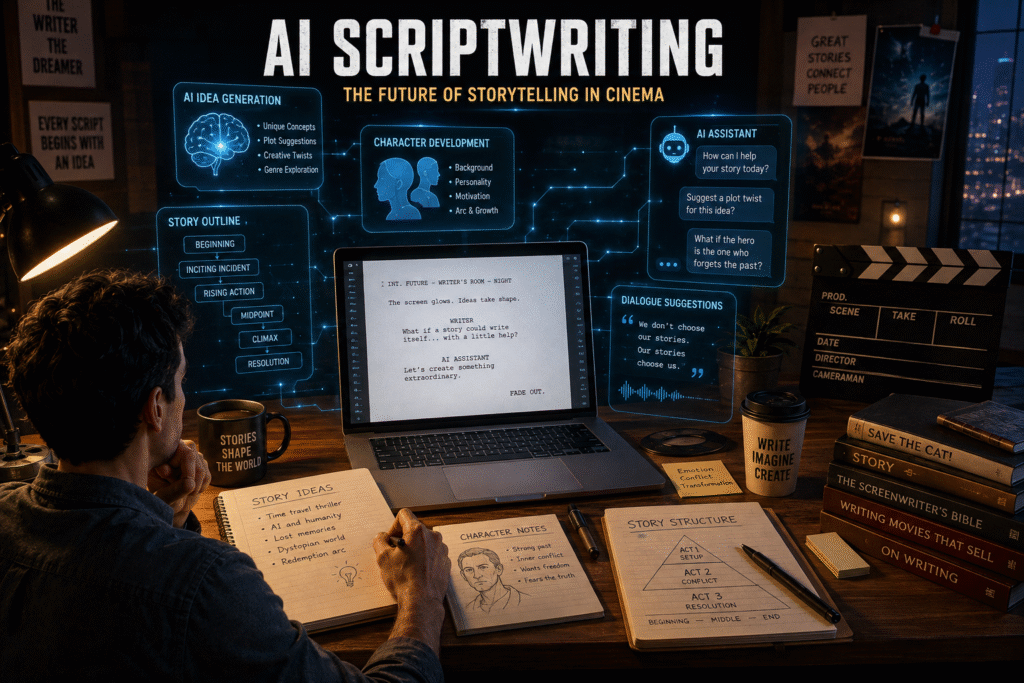
However, AI does not experience emotions or human life experiences. The final creative decisions still depend on human writers.
How Artificial Intelligence Helps Screenwriters
AI is becoming a valuable tool for modern screenwriters by reducing repetitive tasks and providing creative support.
AI can help writers by:
Generating Ideas
Writers can use AI to explore:
- Story concepts
- Plot possibilities
- Character ideas
- Different endings
Improving Structure
AI can analyse screenplay elements such as:
- Three-act structure
- Character development
- Story pacing
- Conflict
Enhancing Creativity
AI can provide alternative approaches and suggestions that writers may not have considered.
Rather than replacing writers, AI works as a brainstorming partner.
AI Scriptwriting in Story Development and Idea Generation
Developing a movie idea can be challenging because writers need to create original concepts that connect with audiences.
AI can assist in the early development stage by helping with:
Modern storytelling is also influenced by technologies discussed in [AI in Cinema: How Artificial Intelligence Is Transforming the Future of Filmmaking], where artificial intelligence is helping filmmakers improve creative workflows.
- Story themes
- World-building
- Character relationships
- Plot variations
- Genre exploration
For example, a writer creating a science-fiction movie can use AI to explore possible futuristic worlds, technologies, and conflicts.
However, human imagination remains essential because meaningful stories come from emotions, experiences, and cultural understanding.
How AI Creates Characters and Dialogue
Characters are the heart of every movie. AI tools can assist writers in developing more detailed and complex characters.
AI can help create:
- Character personalities
- Background stories
- Emotional motivations
- Dialogue suggestions
For dialogue writing, AI can analyse:AI-generated characters are becoming more advanced with technologies like [Digital Humans in Cinema: How AI Is Creating the Future of Virtual Actors].
- Conversation patterns
- Character voices
- Emotional tone
However, memorable characters require human understanding of emotions, relationships, and real-life experiences.
AI can suggest possibilities, but writers bring characters to life.
The Role of AI in Screenplay Analysis
Before production begins, scripts often go through multiple revisions. AI can help analyse screenplays and identify areas for improvement.
AI screenplay analysis can evaluate:
- Story pacing
- Character development
- Dialogue quality
- Scene structure
- Audience appeal
This allows writers and producers to understand potential strengths and weaknesses before filming begins.
AI analysis can save time and provide valuable insights during the development process.
AI Scriptwriting vs Traditional Screenwriting Methods
| AI Scriptwriting | Traditional Screenwriting |
|---|---|
| Uses artificial intelligence tools | Uses human imagination and experience |
| Generates ideas quickly | Requires personal creativity |
| Analyses storytelling patterns | Creates unique emotional connections |
| Assists with revisions | Depends on writer’s perspective |
Traditional screenwriting remains the foundation of cinema because human emotions and personal experiences create meaningful stories.
AI works best as a supporting tool rather than a replacement.
Benefits of Artificial Intelligence in Movie Writing
AI provides several advantages for modern screenwriters.
Faster Idea Development
AI can quickly generate creative possibilities and help writers overcome creative blocks.
Improved Script Analysis
AI can identify structural issues and suggest improvements.
Creative Experimentation
Writers can explore different genres, styles, and storytelling approaches.
Better Production Planning
AI analysis can help producers understand script potential before investing in production.
Support for Independent Filmmakers
Independent creators can use AI tools to improve storytelling without large writing teams.
Challenges and Ethical Concerns of AI-Generated Scripts
Despite its advantages, AI scriptwriting creates several challenges.
Originality Concerns
Questions remain about whether AI-generated ideas are truly original.
Copyright Issues
The ownership of AI-assisted scripts is still being discussed in the creative industry.
Impact on Writers
Many screenwriters are concerned about how AI may affect creative jobs.
Loss of Human Emotion
Stories created only through AI may lack personal experiences and emotional depth.
The film industry must develop responsible guidelines for using AI in storytelling.
Will AI Replace Screenwriters?
One of the biggest questions in modern cinema is whether AI will replace human writers.
The answer is unlikely.
Screenwriting requires:
- Emotional understanding
- Cultural awareness
- Personal experiences
- Human imagination
AI can create patterns and suggestions, but it does not truly understand human emotions.
The future will likely involve collaboration where writers use AI as a creative assistant while maintaining control over storytelling decisions.
The Future of AI Scriptwriting Technology in Cinema
The future of AI scriptwriting will focus on collaboration between humans and technology.
Future developments may include:
- Advanced story analysis
- Personalised storytelling
- AI-assisted character development
- Faster screenplay creation
- Interactive movie experiencesSimilar to [Virtual Production Explained: How Technology Is Creating the Future of Filmmaking], AI scriptwriting will continue changing how movies are developed.
AI will continue to change the filmmaking process, but human creativity will remain the heart of cinema.
The most successful filmmakers will be those who combine traditional storytelling skills with modern AI capabilities.
Conclusion
AI scriptwriting represents a major transformation in the future of filmmaking. Artificial intelligence is helping writers generate ideas, analyse stories, and explore new creative possibilities.
However, great movies are not created only through technology. They are created through human emotions, imagination, and experiences.
AI will not replace storytelling; instead, it will become another powerful tool that helps writers create more innovative and engaging cinematic experiences.
The future of screenwriting belongs to creators who understand how to combine human creativity with artificial intelligence.
External Links
- OpenAI
https://openai.com/ - Writers Guild of America
https://www.wgaeast.org/ - Academy of Motion Picture Arts and Sciences
https://www.oscars.org/ - Adobe Creative Cloud
https://www.adobe.com/