
Film Production Explained: What Happens on Set During a Movie Shoot
Introduction
A film does not come together on the day the cameras start rolling. Before production begins, filmmakers may spend weeks or months developing the script, planning the budget, selecting locations, casting actors and preparing the crew. Once this work is complete, the production moves into one of its most important stages: principal photography.
Principal photography is the period when the planned scenes are actually filmed. It is the stage most people associate with filmmaking, but there is much more happening on a film set than simply pointing a camera at the actors.
The director works with the cast and crew to bring the screenplay to life. The cinematographer decides how each scene will be photographed, the lighting team shapes the image, the sound department records dialogue and the production team keeps the entire shoot moving according to schedule.
Every department has a specific responsibility, but all of them work toward the same goal: capturing the footage needed to create the finished film.
What Is Film Production?
Film production is the stage of filmmaking in which the scenes planned during pre-production are recorded on camera. It includes everything that happens on set, from preparing the location and rehearsing actors to setting up cameras, lighting and sound and capturing the final takes.
Production can take place on a studio set, at real locations, or in a combination of both. The scale of the work depends on the type of project. A small independent film may have a relatively compact crew, while a large feature film can involve hundreds of people across several departments.
Although the camera is at the centre of the process, film production involves much more than camera work.
Preparation of Scenes
Before a scene is filmed, the crew prepares the location, props, costumes and other elements required for the shot. The assistant director and production team coordinate the schedule while individual departments make sure everything is ready.
The set must be prepared before the actors and camera team can begin shooting. Even a relatively short scene may require considerable preparation.
Camera Work
The camera department works closely with the director and cinematographer to determine how each scene should be captured.
This includes decisions about framing, camera position, lenses, camera movement and focus. Different shots are used for different purposes. A wide shot may establish the environment, while a close-up can draw attention to an actor’s expression.
Directing Actors
The director guides the actors through their performances and helps them understand how a scene should be approached.
The director may discuss character motivation, movement, timing and the emotional purpose of the scene. During rehearsals and takes, the director observes the performance and decides whether another take is needed.
Lighting
Lighting gives the cinematographer control over the appearance of a scene.
The lighting team works with the cinematographer to create the required exposure, mood and visual atmosphere. Lighting can also help direct the audience’s attention toward important parts of the frame.
Sound Recording
The sound department records dialogue and other useful audio during filming.
A boom operator may position a microphone close to the actors without allowing it to appear in the frame. Depending on the scene, actors may also use wireless microphones.
Recording clean production sound is important because dialogue captured during filming is often used in the final soundtrack.
Production Design
Production design determines how the physical environment of a film looks.
Sets, furniture, props, decorations and other visual elements are selected or created to suit the story. These details can help establish the period, location and overall character of a film.
Continuity
Continuity ensures that visual and narrative details remain consistent between takes and scenes.
For example, if an actor picks up a glass with their right hand in one shot, the same action should generally remain consistent when the scene is covered from another camera angle.
The script supervisor helps track these details throughout production.
Daily Production Management
A film set operates according to a carefully planned schedule.
The production team coordinates actors, crew, locations, equipment and shooting times throughout the day. Assistant directors play an important role in keeping the production organised and ensuring that the planned work is completed as efficiently as possible.
The Main Stages of Film Production
Although every production has its own workflow, a typical shooting day follows a series of steps. These stages help the crew move from preparation to filming while keeping the creative and technical requirements of each scene under control.
Setting Up the Film Set
The first stage is preparing the set for the day’s work.
The production team makes sure the location is ready and that the required props, costumes and set elements are available. The camera and lighting departments begin preparing their equipment while the sound team checks the recording setup.
The assistant director coordinates the different departments and helps make sure the production is ready to begin on schedule.
A well-organised setup is important because delays at the beginning of the day can affect the rest of the shooting schedule.
Rehearsing the Scene
Before filming begins, the director may rehearse the scene with the actors.
Rehearsals give everyone an opportunity to understand how the scene will play out. The actors can work through their dialogue and movements while the director provides guidance.
The camera and lighting teams can also observe the rehearsal and make adjustments based on the actors’ movements.
Some productions use several rehearsals, while others may rely on a shorter preparation period depending on the scene and schedule.
Blocking the Actors
Blocking refers to planning where the actors will stand and how they will move during a scene.
The director works with the actors to establish their positions and movements. These decisions are important because the actors’ movements affect the camera position, focus, lighting and sound recording.
For example, an actor may need to move from one side of a room to another while delivering dialogue. The camera operator and focus puller need to know this movement in advance so that the shot remains usable.
Blocking therefore connects the performance with the technical requirements of the scene.
Camera and Lighting Setup
Once the blocking has been established, the cinematographer and camera department determine how the scene will be photographed.
The team may choose the camera angle, lens, framing and movement required for the shot. At the same time, the lighting department adjusts the lights to achieve the desired look.
This stage can take time, particularly when the scene involves complicated camera movements or changes in lighting.
The director and cinematographer work together to make sure that the technical setup supports the creative intention of the scene.
Sound Preparation
Before a take, the sound department checks the recording environment.
Unwanted noise can create serious problems during filming, so the crew may need to deal with traffic, machinery, air-conditioning systems, people nearby or other background sounds.
The sound recordist monitors the microphones and recording levels while the boom operator positions the microphone as close to the actors as possible without entering the camera frame.
When everything is ready, the crew can move toward filming the take.
The Director’s Role
The director is responsible for guiding the creative direction of the production.
During filming, the director works with actors, the cinematographer and other department heads to make decisions about how each scene should be captured.
The director may provide notes after a rehearsal, adjust an actor’s performance, change the pace of a scene or request another camera setup.
At the same time, the director has to consider the practical limitations of the production. Time, budget, location restrictions and the shooting schedule can all influence decisions on set.
Good directing therefore involves balancing creative choices with the realities of production.
Shooting the Scene
Once the crew is ready, the scene is filmed.
The familiar sequence of “Action” and “Cut” represents only a small part of what happens around each take. Before the director calls action, the camera, sound and lighting departments must all be ready.
A typical take involves the following:
- The set is prepared.
- The crew takes their positions.
- The camera is ready.
- Sound is checked.
- The slate is called.
- The director calls action.
- The actors perform the scene.
- The director calls cut.
- The take is reviewed.
The same scene may be filmed several times. Different takes may be required to improve the performance, correct a technical issue or capture a different creative approach.
Reviewing Takes
After a take, the director and relevant department heads review what was captured.
The production may check the footage for performance, focus, framing, lighting, sound and continuity.
If something is not satisfactory, the director may ask for another take.
Sometimes the issue is obvious, such as a camera error or missed line. In other cases, the director may simply feel that the performance can be improved.
Reviewing footage during production helps prevent major problems from being discovered only after filming has finished.
Maintaining Continuity
Continuity is one of the less visible but important parts of film production.
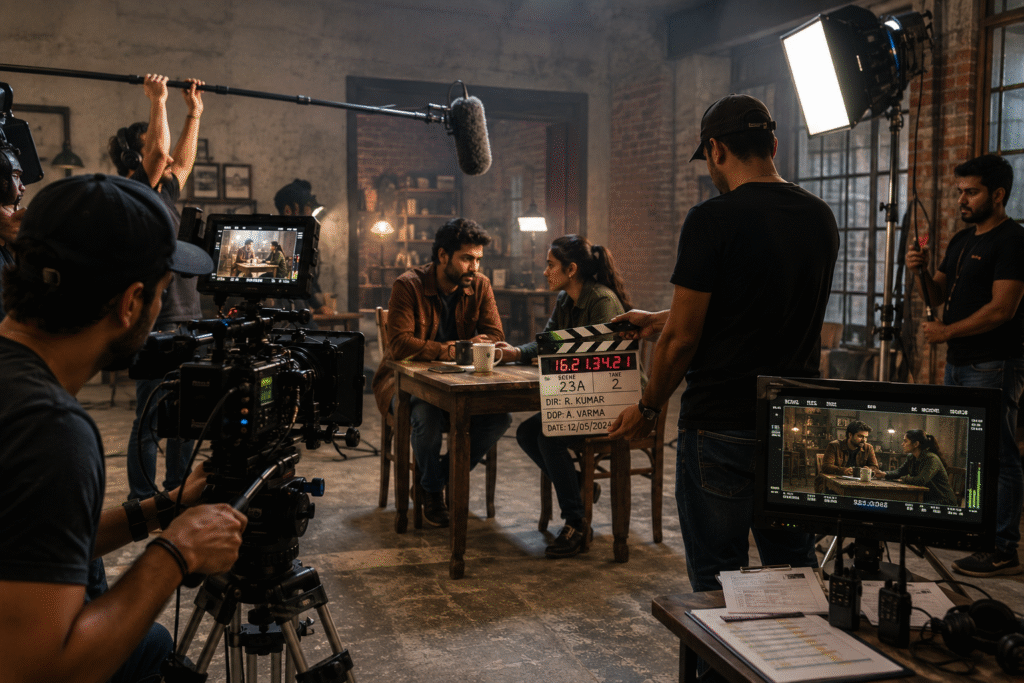
A film may not be shot in the same order in which the audience eventually sees the story. A scene that appears early in the finished movie could be filmed days after another scene that takes place later in the story.
Because of this, the production team needs to carefully track details from one shooting day to another.
Continuity may involve checking:
- Actor positions
- Costume details
- Hair and makeup
- Props
- Dialogue
- Hand movements
- Background elements
- Camera positions
- Lighting
- Scene progression
The script supervisor records important information about each take so that the editing team has consistent material to work with later.
Moving to the Next Setup
Once a scene or shot has been successfully captured, the crew moves to the next setup.
This may involve changing the camera position, adjusting lighting, moving equipment or preparing another section of the scene.
The production team needs to make these changes efficiently because time on a film set is limited.
The assistant director helps coordinate the transition while department heads prepare their teams for the next shot. Actors may move to new positions, the camera may be repositioned and the lighting team may create a different setup.
This process continues throughout the shooting day until the planned scenes for that day have been completed.
Film production is therefore a continuous cycle of preparation, rehearsal, setup, filming, review and adjustment. Every successful take brings the production one step closer to the finished film.