
Why choose this topic?
This is one of the most trending future topics after AI, Virtual Production, and Motion Capture.
The film industry is moving towards creating realistic digital humans that can:
- Act in movies
- Perform without physical limitations
- Appear younger or older
- Create fictional characters
- Work with real actors
This topic connects perfectly with your previous blogs:
- AI in Cinema
- Motion Capture Technology
- Virtual Production
- VFX
- Acting
It will attract searches like:
- “Will AI replace actors?”
- “How are digital humans created?”
- “Future of virtual actors”
- “AI generated movie characters”
Primary Keywords
- Digital Humans in Cinema
- Virtual Actors
- AI Generated Characters
- Digital Characters in Movies
- Future of Filmmaking
- AI in Movies
- Virtual Humans Technology
Secondary Keywords
- How digital humans are created
- AI actors in movies
- CGI humans
- Virtual characters
- Digital performance technology
- Future of actors in cinema
- Artificial intelligence filmmaking
LSI Keywords
- Artificial intelligence
- Motion capture
- Facial animation
- Performance capture
- CGI
- VFX artists
- Virtual production
- Machine learning
- Digital avatars
- Realistic characters
- Hollywood technology
- Film innovation
Blog Description
The future of cinema is entering a new era where technology can create digital humans that look, move, and perform like real people. With advancements in artificial intelligence, motion capture, and visual effects, filmmakers can now develop realistic virtual characters for movies, games, and digital experiences.
Digital humans are changing the way characters are designed and presented on screen. They allow filmmakers to create impossible performances, preserve legendary characters, and explore new storytelling possibilities.
However, the rise of virtual actors also raises important questions about creativity, ethics, copyright, and the future role of human performers. This blog explores how digital humans are created, their impact on cinema, and what the future holds for AI-powered characters.
Digital Humans in Cinema are becoming one of the most exciting developments in modern filmmaking. With advancements in artificial intelligence, CGI, motion capture, and visual effects, filmmakers can now create highly realistic virtual characters that look, move, and express emotions like real human beings.
For decades, cinema has used technology to expand storytelling possibilities. From practical effects to computer-generated characters, every innovation has changed how audiences experience movies. Today, digital humans represent the next step in this evolution by allowing filmmakers to create characters that exist completely inside the digital world.
While digital humans offer incredible creative opportunities, they also raise important questions about the future of acting, creativity, copyright, and the relationship between technology and human performance.
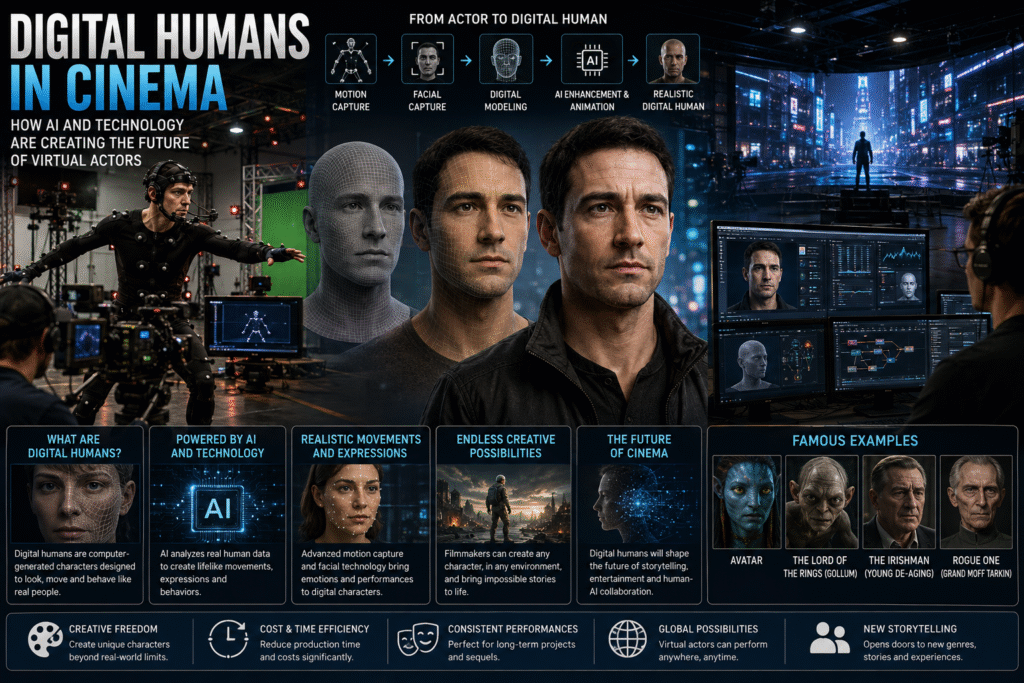
What Are Digital Humans in Cinema?
Digital humans are computer-generated characters designed to look and behave like real people. They are created using advanced technologies such as artificial intelligence, CGI, facial animation, and motion capture.
Unlike traditional animated characters, digital humans focus on achieving realistic human qualities, including:
- Facial expressions
- Body movements
- Emotional reactions
- Natural speech
- Human-like appearance
In cinema, digital humans can be used as:
- Virtual actors
- Digital characters
- Younger or older versions of actors
- Fantasy or futuristic characters
- Fully computer-generated performers
These technologies allow filmmakers to create characters that would be impossible to produce through traditional filming methods.
How Digital Humans Are Created Using AI and CGI
Creating a realistic digital human requires a combination of multiple technologies.
1. 3D Character Modelling
Artists create a detailed digital model of the character, including:
- Face structure
- Skin details
- Hair
- Body features
2. Artificial Intelligence
AI helps analyse human expressions, movements, and behaviours to create more realistic digital performances.
3. Computer-Generated Imagery (CGI)
CGI artists add:
- Realistic textures
- Lighting effects
- Skin details
- Environmental interaction
4. Animation Technology
The digital human is animated using movement data collected from actors or AI systems.
The combination of these technologies creates virtual characters that can appear almost identical to real humans.
The Role of Motion Capture in Digital Human Creation
Motion capture technology plays an important role in creating realistic digital humans.
Actors wear specialised equipment that records:
- Body movements
- Facial expressions
- Eye movements
- Emotional performances
This data is transferred to digital characters, allowing them to perform naturally.
Motion capture helps digital humans feel more realistic because the performance comes from a real human actor.
Related:
[Motion Capture Technology Explained: How Digital Characters Come to Life in Movies]
How Facial Technology Creates Realistic Virtual Characters
Facial technology is one of the most challenging parts of creating digital humans.
Advanced facial capture systems record small details such as:
- Eye movement
- Facial muscle changes
- Smiles
- Emotional expressions
These details are applied to digital characters to create believable performances.
Realistic facial animation helps audiences connect emotionally with virtual characters.
Digital Humans vs Traditional Actors
Digital humans and traditional actors have different strengths.
| Digital Humans | Traditional Actors |
|---|---|
| Can exist in any environment | Provide real human emotions |
| Can appear any age | Bring personal experiences |
| Can perform impossible actions | Create authentic performances |
| Can be digitally modified | Provide natural creativity |
Although digital humans offer new possibilities, human actors remain essential because storytelling depends on emotion, personality, and human connection.
How AI Is Changing Character Development in Movies
Artificial intelligence is changing how filmmakers design and develop characters.
AI can help with:
- Character appearance generation
- Behaviour analysis
- Voice creation
- Performance improvement
- Story development
Filmmakers can now experiment with new types of characters and explore creative ideas that were previously difficult to achieve.
AI acts as a creative assistant, helping artists develop more complex and visually impressive characters.
Famous Examples of Digital Characters in Cinema
Many successful movies have used digital characters and virtual performances.
Avatar Series
The films used advanced digital characters and performance capture technology to create the Na’vi world.
The Lord of the Rings
The character Gollum became one of the most famous examples of a digital character created through performance capture.
Planet of the Apes Series
The movies used advanced CGI and motion capture to create realistic digital apes with emotional performances.
Marvel Movies
Many superhero films use digital characters and CGI-based performances for action sequences and fantasy elements.
Benefits of Virtual Actors in Filmmaking
Digital humans provide many benefits for modern filmmakers.
Creative Freedom
Filmmakers can create characters beyond physical limitations.
Unlimited Possibilities
Virtual actors can appear in any environment or time period.
Cost Efficiency
Digital characters can reduce the need for complex physical production setups.
Character Preservation
Digital versions of characters can continue appearing in future projects.
New Storytelling Opportunities
Creators can explore completely new cinematic experiences.
Challenges and Ethical Concerns of Digital Humans
Despite their advantages, digital humans create important challenges.
Impact on Human Actors
Actors are concerned about how virtual performers may affect future opportunities.
Copyright and Ownership
Questions remain about who owns digital versions of human performances.
Authenticity Issues
Audiences may question whether digital performances have genuine emotional value.
Technology Limitations
Creating realistic digital humans requires expensive equipment and specialised skills.
The film industry must develop ethical guidelines for responsible use of this technology.
The Future of Digital Humans with AI Technology
The future of digital humans will be strongly connected with artificial intelligence.
Future developments may include:
- AI-powered virtual actors
- Real-time digital performances
- Interactive movie characters
- Personalised entertainment experiences
- More realistic digital personalities
As AI technology improves, digital humans may become an important part of movies, games, and virtual experiences.
However, the emotional power of cinema will continue to depend on human creativity and storytelling.
Conclusion
Digital humans represent a major evolution in filmmaking technology. By combining AI, CGI, motion capture, and visual effects, filmmakers can create characters that expand the possibilities of storytelling.
While virtual actors provide exciting opportunities, they also create important discussions about creativity, ethics, and the future of human performances.
The future of cinema will likely not be humans versus technology. Instead, digital humans will become another powerful tool that helps filmmakers create bigger, more imaginative, and more immersive stories.
External Links
- Unreal Engine
https://www.unrealengine.com/ - NVIDIA AI
https://www.nvidia.com/ - Industrial Light & Magic
https://www.ilm.com/ - Academy Awards
https://www.oscars.org/