
Why choose this topic?
Virtual production is one of the biggest transformations happening in modern cinema. After AI, this is the next major technology changing how movies are created.
Major studios are using virtual production to create realistic worlds without traditional sets. It combines:
- LED wall technology
- Real-time CGI
- Game engines
- Motion capture
- Artificial intelligence
- Digital environments
This topic is highly relevant because audiences are curious about:
- How movies create realistic fantasy worlds
- How filmmakers shoot scenes without real locations
- How technology reduced production costs
- How future movies will be made
Introduction
The filmmaking industry has always evolved with technology. From practical effects and green screens to advanced CGI and artificial intelligence, every innovation has changed how stories are brought to life. Today, virtual production is becoming one of the most important advancements in modern cinema.
Virtual production combines real-world filmmaking with digital technology, allowing filmmakers to create realistic environments, locations, and visual effects while actors perform on physical sets. Instead of travelling to expensive locations or building large physical sets, filmmakers can now create entire digital worlds using LED screens, game engines, and real-time rendering.
This revolutionary approach is changing how directors, cinematographers, and visual effects artists create movies. It provides greater creative freedom, reduces production challenges, and opens new possibilities for storytelling.
What Is Virtual Production?
Virtual production is a filmmaking technique that combines live-action footage with computer-generated environments in real time. It allows filmmakers to see and interact with digital worlds while shooting scenes.
Unlike traditional filmmaking methods where visual effects are added after filming, virtual production integrates digital elements during the actual shoot.
The technology combines:
- LED wall displays
- Real-time computer graphics
- Game engine technology
- Motion capture
- Camera tracking systems
- Artificial intelligence
Virtual production helps filmmakers create realistic cinematic environments while maintaining the feeling of a traditional film set.
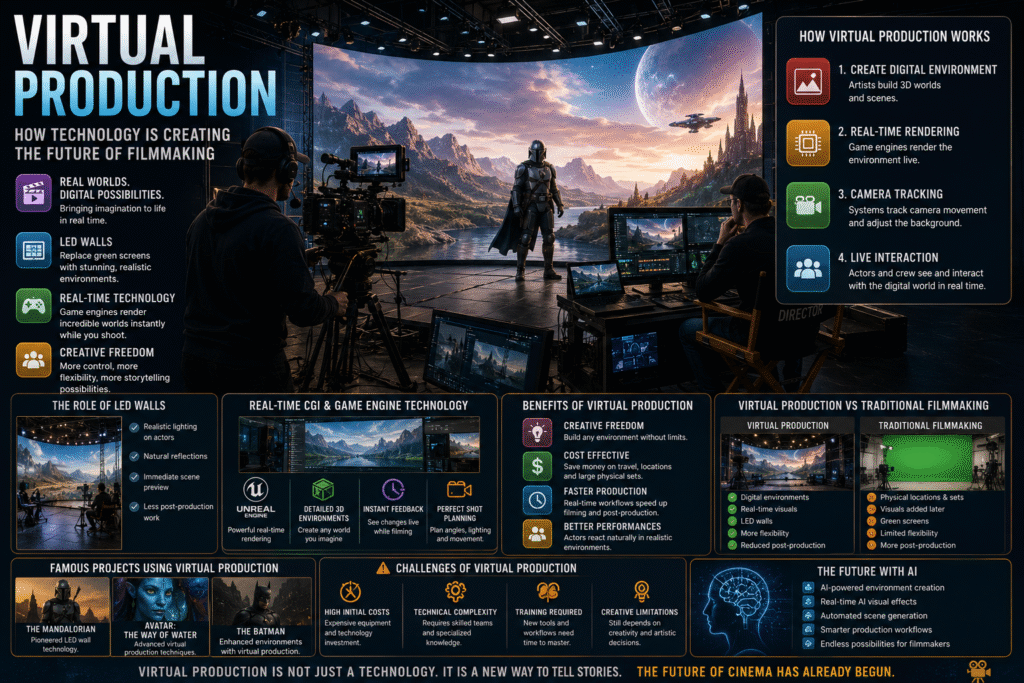
How Virtual Production Works in Modern Filmmaking
Virtual production works by connecting cameras, computers, and digital environments into one interactive filmmaking system.
The process usually involves:
1. Creating Digital Environments
Artists create 3D worlds, locations, and backgrounds using advanced software.
2. Real-Time Rendering
Computer systems generate digital environments instantly while filming.
3. Camera Tracking
Special tracking systems understand camera movement and adjust digital backgrounds according to the camera angle.
4. Live Interaction
Actors and directors can see the digital environment while performing, making creative decisions easier.
This process allows filmmakers to combine real performances with digital worlds seamlessly.
The Role of LED Walls in Movie Production
LED walls are one of the biggest innovations behind virtual production.
Large LED screens replace traditional green screens by displaying realistic digital environments behind actors.
Benefits of LED walls include:
- Realistic lighting on actors
- Natural reflections
- Better visual accuracy
- Immediate preview of scenes
- Reduced post-production work
Unlike green screens, LED technology allows actors to see their surroundings, helping them deliver more realistic performances.
LED walls have become an important tool in modern science-fiction, fantasy, and large-scale productions.
Real-Time CGI and Game Engine Technology
One of the key technologies behind virtual production is real-time CGI.
Game engines originally developed for video games are now being used in filmmaking because they can create detailed environments instantly.
Popular technologies include:
- Real-time rendering engines
- 3D environment creation
- Digital simulations
- Interactive visual effects
These tools allow directors and cinematographers to experiment with camera angles, lighting, and environments before finalising scenes.
Real-time technology makes filmmaking faster and gives creators more control over their vision.
How Virtual Production Changed Visual Effects
Traditional visual effects are usually created after filming during post-production. Virtual production changes this approach by bringing digital effects into the filming stage
It helps VFX teams by:
- Reducing post-production workload
- Improving creative planning
- Creating realistic environments
- Allowing instant visual feedback
Visual effects artists can collaborate with filmmakers earlier in the process, resulting in better integration between real and digital elements.
Virtual does not replace VFX; instead, it enhances the entire visual effects workflow.
The Benefits of Virtual Production for Filmmakers
Virtual production provides many advantages for modern filmmakers.
Creative Freedom
Directors can create any environment without physical limitations.
Reduced Production Costs
Filmmakers can avoid expensive travel and large physical sets.
Better Planning
Teams can preview scenes before completing full production.
Improved Actor Performance
Actors can interact with realistic environments instead of imagining backgrounds.
Faster Production
Real-time technology reduces time spent on certain post-production tasks.
These benefits make virtual production valuable for both large studios and independent filmmakers.
Virtual Production vs Traditional Filmmaking
| Virtual Production | Traditional Filmmaking |
|---|---|
| Uses digital environments | Uses physical locations and sets |
| Real-time visual feedback | Effects added later |
| LED walls and CGI technology | Green screens and practical sets |
| Faster creative adjustments | Requires more post-production work |
| Greater location flexibility | Limited by physical locations |
Both methods continue to play important roles. Many modern productions combine traditional filmmaking techniques with virtual production technology.
Famous Movies and Shows Using Virtual Production
Several major productions have used virtual production techniques to create immersive worlds.
Examples include:
The Mandalorian
One of the most famous examples of LED wall technology in filmmaking. The used environments to create realistic alien planets and locations.
Avatar: The Way of Water
Used advanced digital technology and motion capture to create detailed underwater worlds.
The Batman
Used virtual production techniques to enhance environments and visual storytelling.
These projects demonstrate how technology can expand cinematic possibilities.
Challenges of Virtual Production
Although virtual production offers many benefits, it also has challenges.
High Initial Costs
LED walls, technology systems, and equipment require significant investment.
Technical Complexity
Teams need specialised knowledge to operate virtual production systems.
Creative Limitations
Digital environments still require skilled artists and filmmakers to achieve realistic results.
Training Requirements
Filmmakers must learn new workflows and technologies.
As technology improves, these challenges will become easier to manage.
The Future of Virtual Production with AI
Artificial intelligence will play a major role in the future of virtual production.
AI can improve:
- Digital environment creation
- Real-time visual effects
- Automated scene generation
- Camera planning
- Production workflows
The combination of AI and virtual production could allow filmmakers to create complex cinematic worlds faster and more efficiently.
Future movies may use AI-powered virtual environments where creators can design entire worlds with greater speed and creativity.Virtual Production
Conclusion
Virtual production is changing the future of filmmaking by combining creativity with advanced technology. Through LED walls, real-time CGI, and digital environments, filmmakers can create cinematic experiences that were once impossible.
While traditional filmmaking methods remain important, virtual production provides new opportunities for storytelling, efficiency, and creative exploration.
As technology continues to evolve, virtual production will become an essential part of modern cinema, helping filmmakers build bigger, more immersive, and more imaginative worlds for audiences worldwide.
Internal Links
Add links to:
- AI in Cinema: How Artificial Intelligence Is Transforming the Future of Filmmaking
- The Evolution of Visual Effects (VFX): How Technology Transformed Modern Cinema
- The Magic of Cinematography: How Camera Angles and Lighting Shape Every Movie
- The Role of Production Design: Building Immersive Worlds in Cinema
- The Complete Journey of a Movie: From Script to Screen
- The Art of Film Editing: The Invisible Storyteller
External Links
Use:
- Unreal Engine
https://www.unrealengine.com/ - NVIDIA
https://www.nvidia.com/ - Academy of Motion Picture Arts and Sciences
https://www.oscars.org/ - Industrial Light & Magic
https://www.ilm.com/ - ARRI
https://www.arri.com/
Primary Keywords
- Virtual Production in Filmmaking
- Future of Filmmaking
- LED Wall Technology
- Real-Time CGI
- Digital Filmmaking
- Modern Film Technology
Secondary Keywords
- How virtual production works
- Virtual sets in movies
- Unreal Engine filmmaking
- Motion capture technology
- CGI environments
- Digital filmmaking techniques
- Future movie technology
LSI Keywords
- LED volume
- Unreal Engine
- Real-time rendering
- Visual effects
- Cinematography
- Digital environments
- Motion capture
- Filmmakers
- Directors
- Production design
- CGI
- 3D worlds
- Film technology