
Introduction
Film cinematography is the visual language of filmmaking. It is the process of deciding how a story will be photographed through camera placement, lenses, lighting, framing, movement, colour and composition. These choices determine not only what audiences see, but also how they experience a scene.
A strong film cinematography approach helps establish mood, atmosphere, character perspective and visual continuity. From a simple close-up to a carefully designed wide shot, every visual decision can contribute to the meaning of a scene.
The cinematographer works closely with the director and other departments to turn the creative vision of a screenplay into a consistent visual style. These decisions begin during pre-production and continue throughout principal photography.
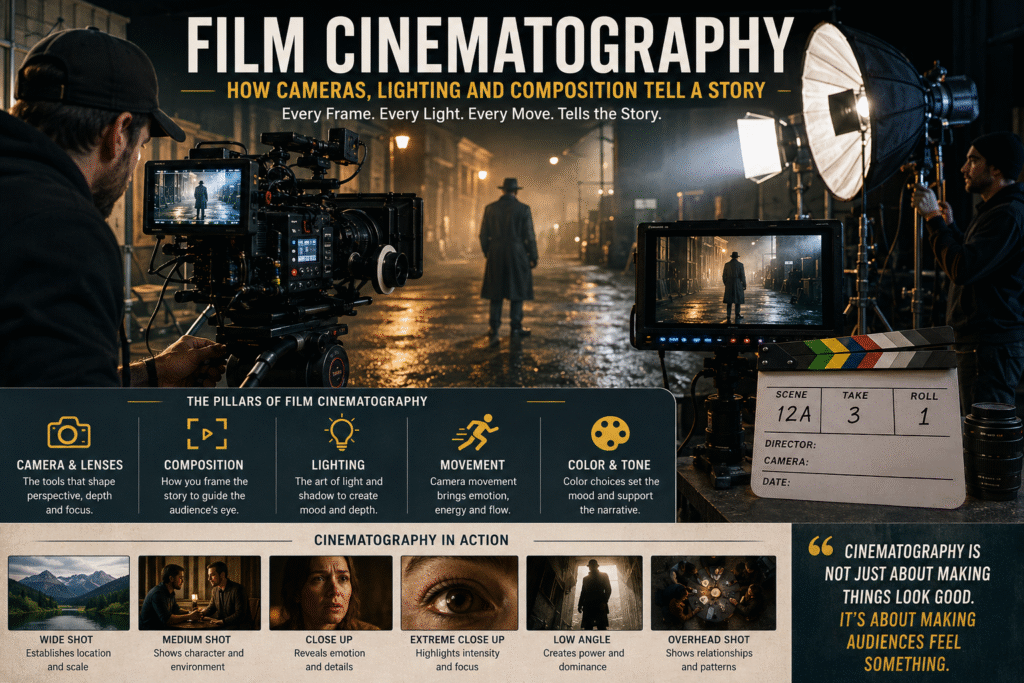
What Is Film Cinematography?
Film cinematography is the art and technical practice of creating the visual images of a movie.
It involves making decisions about:
- Cameras
- Lenses
- Lighting
- Framing
- Composition
- Camera movement
- Exposure
- Colour
- Depth of field
- Aspect ratio
- Visual continuity
Cinematography is not simply about operating a camera. It is about deciding how the audience experiences the story visually.
A scene can be filmed in many different ways, and each approach can create a different emotional response.
Why Is Film Cinematography Important?
The visual presentation of a film can influence how audiences understand characters, locations and events.
Cinematography can help:
- Establish mood
- Direct audience attention
- Create atmosphere
- Introduce characters
- Show relationships
- Build tension
- Establish location
- Support the story
- Create visual continuity
- Develop a recognisable visual style
A filmmaker may use a wide shot to show a character’s isolation or a close-up to bring attention to a subtle facial expression.
These choices allow visual storytelling to work alongside dialogue, sound and editing.
What Does a Cinematographer Do?
A cinematographer, also known as a Director of Photography (DP), is responsible for the photographic and visual approach of a film.
The cinematographer works closely with the director to determine how the story should look on screen.
Their responsibilities can include:
- Camera selection
- Lens selection
- Lighting design
- Exposure
- Framing
- Camera movement
- Visual references
- Camera tests
- Lighting tests
- Shot planning
- Collaboration with the production designer
- Coordination with the camera and lighting departments
On larger productions, the cinematographer leads a specialised team that helps execute the visual plan.
The Main Elements of Film Cinematography
Several elements work together to create the visual language of a movie.
Camera and Lens Selection
The camera records the image, while the lens influences how that image appears.
Different lenses can change:
- Field of view
- Perspective
- Depth of field
- Compression
- Distortion
- Relationship between foreground and background
The choice of camera and lens should support the creative requirements of the scene.
Framing and Composition
Framing determines what appears inside the image and how visual elements are arranged.
Composition can guide the audience toward a character, object or part of the environment.
Important considerations include:
- Subject placement
- Negative space
- Symmetry
- Leading lines
- Foreground and background
- Balance
- Visual depth
Lighting
Lighting determines how subjects and environments are presented.
It can establish:
- Mood
- Time of day
- Depth
- Contrast
- Texture
- Character emphasis
Lighting may be natural, artificial or a combination of both.
Colour and Exposure
Colour and exposure contribute significantly to the overall appearance of a film.
The cinematographer considers how bright or dark an image should be and how colours should appear under different lighting conditions.
These decisions also provide a foundation for the later film colour grading process.
Camera Movement
Camera movement can change how an audience experiences a scene.
A stationary camera may create a calm or observational feeling, while movement can introduce energy, tension or intimacy.
Depth of Field
Depth of field refers to how much of the image appears acceptably sharp.
A shallow depth of field can isolate a character from the background, while a deeper focus can keep several elements visible at the same time.
Aspect Ratio
Aspect ratio describes the relationship between the width and height of the image.
Different aspect ratios can create different visual experiences and may be selected based on the creative requirements of the film and its intended presentation.
Types of Camera Shots in Film
Camera shots help establish the relationship between the audience and the subject.
Extreme Wide Shot
An extreme wide shot places the subject within a large environment.
It can establish scale, location or isolation.
Wide Shot
A wide shot usually shows the subject along with a significant amount of the surrounding environment.
It is useful for showing movement, location and relationships between characters.
Medium Shot
A medium shot generally frames a character from around the waist or chest upward.
It provides a balance between facial expression, body language and surrounding context.
Close-Up
A close-up focuses closely on a character’s face or another important subject.
It can draw attention to emotion, detail or reaction.
Extreme Close-Up
An extreme close-up shows a very small part of the subject, such as an eye, hand or object.
It can create emphasis or tension.
Camera Angles in Film
Camera angle affects how a subject is presented to the audience.
Eye-Level Shot
An eye-level shot places the camera approximately at the subject’s eye level.
It often creates a natural and neutral perspective.
High-Angle Shot
A high-angle shot places the camera above the subject.
Depending on context, it can make a character appear vulnerable, isolated or visually smaller.
Low-Angle Shot
A low-angle shot places the camera below the subject.
It can make a character appear powerful, dominant or imposing.
Overhead Shot
An overhead shot looks down on the scene from above.
It can provide a strong sense of geography, pattern or visual isolation.
Dutch Angle
A Dutch angle tilts the camera so that the horizon is no longer level.
It is often used to create a sense of unease, instability or disorientation.
Camera Movement Techniques
Camera movement is another important part of film cinematography.
Pan
A pan moves the camera horizontally from one side to another.
It can follow a subject or reveal information within a scene.
Tilt
A tilt moves the camera vertically while maintaining its position.
It can reveal height, introduce a subject or follow movement.
Dolly
A dolly moves the camera physically toward or away from the subject.
It can create a feeling of intimacy, tension or visual emphasis.
Tracking
Tracking involves moving the camera alongside a subject or through an environment.
It is commonly used to follow characters while they move.
Crane and Jib
Crane and jib movements allow the camera to move vertically and across a larger area.
They can provide broad establishing views or dynamic transitions.
Handheld Camera
Handheld shooting introduces natural camera movement.
It can create immediacy, realism, instability or documentary-style energy.
Steadicam and Gimbal
Stabilisation systems allow filmmakers to move the camera while maintaining smoother footage.
They can be particularly useful for following characters through complex environments.
Film Lighting Techniques
Lighting is one of the most important tools available to a cinematographer.
Key Light
The key light is the primary light source used to illuminate a subject.
Its direction and intensity influence the appearance of the subject and the overall mood.
Fill Light
Fill light helps control shadows created by the key light.
The amount of fill can influence the contrast of the image.
Backlight
Backlight illuminates a subject from behind.
It can help separate the subject from the background and create depth.
Three-Point Lighting
Three-point lighting commonly uses:
- Key light
- Fill light
- Backlight
It provides a basic framework for controlling the illumination of a subject.
Natural Lighting
Natural light comes from existing environmental sources such as sunlight.
It can produce realistic results but can also present challenges because its intensity and direction can change.
Low-Key Lighting
Low-key lighting uses stronger contrast and deeper shadows.
It can be effective for dramatic, mysterious or suspenseful scenes.
High-Key Lighting
High-key lighting generally produces brighter images with softer and less pronounced shadows.
It is often associated with lighter or more evenly illuminated visual styles.
How Composition Creates Visual Meaning
Composition is more than arranging attractive images.
The placement of subjects within the frame can communicate information about relationships, power, distance and emotional states.
For example, a character positioned alone within a large empty frame may appear isolated.
A tightly composed frame can create a feeling of restriction, while an open composition may communicate freedom or space.
The cinematographer can use:
- Symmetry
- Leading lines
- Negative space
- Depth
- Foreground elements
- Background details
- Framing within the frame
to guide how audiences read the image.
How Lenses Affect the Look of a Film
Lenses influence the relationship between objects and their surroundings.
Wide-Angle Lenses
Wide lenses capture more of the environment and can emphasise spatial relationships.
Standard Lenses
Standard lenses can provide a relatively natural perspective and are commonly used for a variety of scenes.
Telephoto Lenses
Telephoto lenses provide a narrower field of view and can create stronger visual compression between foreground and background elements.
The right lens depends on the story, location, camera position and desired visual effect.
Cinematography and Visual Storytelling
Film cinematography becomes most effective when technical choices serve the story.
A camera angle can communicate a character’s changing position in a relationship.
Lighting can suggest a character’s emotional state.
A change in colour can distinguish different periods or locations.
Camera movement can reflect the energy of a sequence.
These choices allow filmmakers to communicate information visually instead of relying entirely on dialogue.
How Directors and Cinematographers Work Together
The director is responsible for the overall creative direction of the film, while the cinematographer translates much of that vision into photographic decisions.
Their collaboration may involve discussions about:
- Visual references
- Shot design
- Camera movement
- Lighting
- Lenses
- Composition
- Colour
- Locations
- Character perspective
The strongest results usually come from close communication between the director and cinematographer throughout production.
Cinematography During Film Pre-Production
Many cinematography decisions are made before filming begins.
During film pre-production, the cinematographer may work on:
- Camera tests
- Lens tests
- Lighting tests
- Location visits
- Storyboards
- Shot lists
- Visual references
- Equipment planning
Testing allows the team to identify technical issues before they affect the shooting schedule.
It also gives the director and cinematographer an opportunity to establish a consistent visual approach.
Cinematography During Production
Once filming begins, the cinematographer works with the camera and lighting departments to execute the visual plan.
Daily responsibilities can include:
- Preparing camera setups
- Adjusting lighting
- Checking exposure
- Working with lenses
- Reviewing compositions
- Monitoring camera movement
- Maintaining visual continuity
The plan may still change during production because of weather, locations, performances or other practical circumstances.
A good cinematographer needs both preparation and the ability to adapt.
Common Film Cinematography Mistakes
Poor Exposure
Incorrect exposure can result in lost detail in highlights or shadows.
Inconsistent Lighting
Significant differences in lighting between connected shots can make editing feel unnatural.
Unmotivated Camera Movement
Camera movement should generally serve the scene rather than distract from it.
Overuse of Shallow Focus
A shallow depth of field can look attractive, but excessive use may make important visual information difficult to see.
Weak Composition
Poor framing can make scenes feel visually confusing or fail to direct audience attention.
Ignoring Continuity
Changes in camera position, lighting or screen direction can create visual inconsistencies between shots.
Choosing Style Over Story
A visually impressive shot is not necessarily the right shot for the story.
How Cinematography Works With Film Editing and Colour Grading
Cinematography does not exist independently from the rest of filmmaking.
The footage captured by the cinematographer becomes the material used by the editor.
During film editing, shots are selected and arranged to create the final rhythm and structure of the movie.
Later, colour grading can refine the colour, contrast and visual consistency of the completed picture.
Cinematography, editing and colour grading therefore form an interconnected visual workflow.
Film Cinematography for Independent Filmmakers
Independent filmmakers may not have access to the equipment and resources available on large productions.
That does not prevent them from developing a strong visual style.
Independent productions can focus on:
- Careful location selection
- Available natural light
- Simple but effective lighting
- Consistent camera settings
- Thoughtful composition
- Purposeful camera movement
- Strong shot planning
The quality of cinematography depends on creative decisions as much as expensive equipment.
The Relationship Between Cinematography and Production Design
Cinematography and production design need to work together.
The production designer controls many of the physical elements visible within the frame, while the cinematographer determines how those elements are photographed.
Their collaboration can involve:
- Colour palettes
- Set design
- Props
- Textures
- Lighting
- Camera angles
- Composition
A carefully designed set can lose its visual impact if it is not photographed effectively, just as strong cinematography can be weakened by poorly considered production design.
Cinematography and Film Sound
Although cinematography focuses primarily on images, it works alongside sound to create the complete cinematic experience.
The camera shows the audience where to look, while sound can provide information that exists outside the frame.
For example, a character may look toward an unseen location while an off-screen sound suggests that something is approaching.
This interaction between image and sound allows filmmakers to expand the world beyond what is directly visible.
How Cinematography Supports Different Film Genres
Different genres may use different visual approaches, but there are no strict rules.
Drama
Drama may rely on naturalistic lighting, controlled camera movement and compositions that emphasise character relationships.
Horror
Horror can use darkness, unusual angles, restricted framing and controlled movement to create uncertainty.
Action
Action films may use dynamic camera movement, wider lenses and carefully designed compositions to emphasise movement and scale.
Romance
Romantic films may use softer lighting, warm colour treatments and intimate framing.
Science Fiction
Science-fiction films often combine detailed production design with carefully controlled lighting, camera movement and visual effects.
The visual style should ultimately support the individual story.
Film Cinematography and Visual Effects
Cinematographers often work closely with VFX teams when scenes require digital environments, creatures or other visual effects.
The VFX team needs information about:
- Camera position
- Lens
- Camera movement
- Lighting
- Exposure
- Perspective
Matching these elements helps computer-generated imagery integrate naturally with the live-action footage.
This is particularly important for green-screen and motion-tracking sequences.
Final Thoughts
Film cinematography is one of the fundamental storytelling tools in filmmaking.
Every camera angle, lens, lighting decision, composition and movement can influence how audiences experience a scene.
The cinematographer’s role is not simply to create beautiful images. It is to create images that serve the story, support the director’s vision and work naturally with production design, editing, sound and visual effects.
Strong cinematography begins during preparation and continues through every day of production. When technical knowledge and creative judgement work together, the camera becomes more than a recording device. It becomes an essential part of the storytelling process.