
Introduction
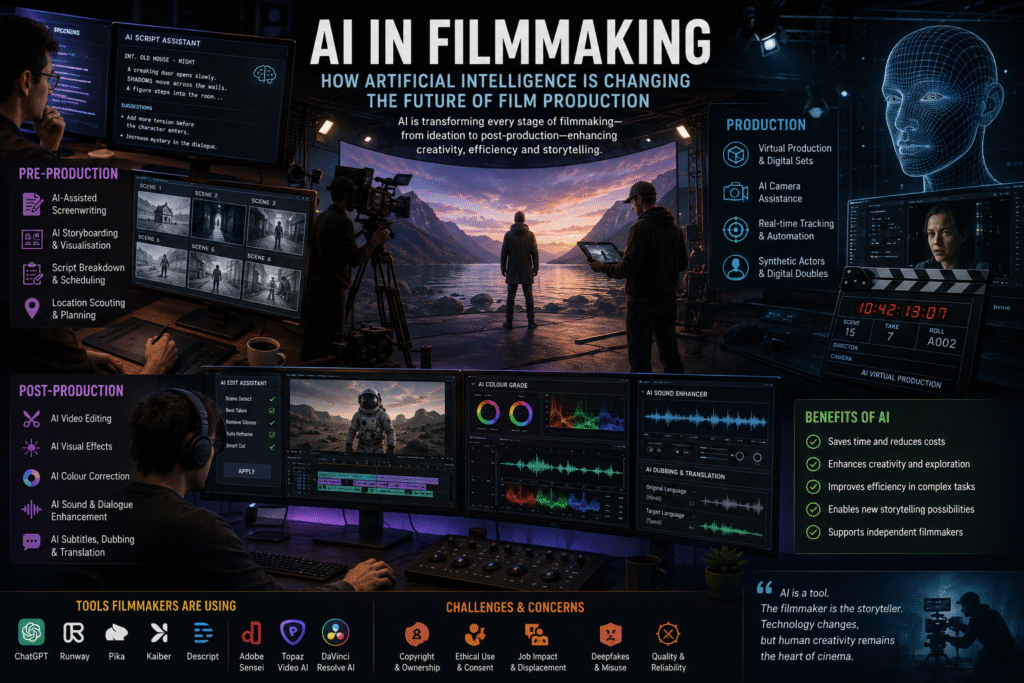
AI in filmmaking has moved from an experimental technology to a practical part of the modern film-production conversation. In 2026, artificial intelligence is being explored across development, pre-production, production and post-production, including storyboarding, visualisation, production planning, editing, sound, image generation, subtitling and dubbing.
The important question is no longer simply whether AI can be used to make films. The more useful question is where AI adds value, where human judgement remains essential and how filmmakers can use the technology responsibly.
In India, the discussion is particularly active. Government-backed sessions at the 2026 Mumbai International Film Festival examined AI’s role in filmmaking, while industry participants emphasised that AI can expand creative possibilities without eliminating the importance of human creativity and emotional intelligence.
What Is AI in Filmmaking?
AI in filmmaking refers to the use of artificial intelligence technologies to assist, automate or enhance different stages of film creation.
Depending on the workflow, AI can support:
- Story development
- Script analysis
- Storyboarding
- Previsualisation
- Production planning
- Image generation
- Video generation
- Editing
- Visual effects
- Sound design
- Voice processing
- Subtitling
- Dubbing
- Localisation
AI does not represent one single filmmaking tool. Instead, it is becoming a collection of technologies that can be integrated into different parts of an existing production workflow.
How AI Is Changing the Film Industry in 2026
The most significant change is that AI is increasingly being considered across the entire production pipeline, rather than only for generating images or video.
Industry analysis in 2026 identifies potential AI applications ranging from development and pre-production to physical production and post-production.
This includes tasks such as:
- Script breakdowns
- Storyboards
- Visualisation
- Production planning
- Editing
- Image generation
- Sound and music workflows
- Subtitling
- Dubbing
At the same time, the industry is still determining where AI provides genuine production value and where human creative judgement remains essential.
How AI Is Used in Film Pre-Production
Pre-production is one of the areas where AI can help filmmakers organise ideas and explore possibilities before cameras begin rolling.
AI-Assisted Screenwriting
AI tools can help writers brainstorm ideas, explore alternative story directions and analyse existing script material.
However, generated material still requires human review for:
- Character development
- Originality
- Narrative consistency
- Dialogue quality
- Cultural context
- Emotional depth
The writer remains responsible for the creative direction of the screenplay.
AI Story Development
Filmmakers can use AI to explore different versions of a concept before committing resources to production.
For example, a filmmaker might experiment with:
- Character concepts
- Story structures
- Alternative endings
- Scene ideas
- Genre variations
This can make early-stage experimentation faster, but speed does not automatically produce better storytelling.
AI Script Breakdown
Script breakdown is traditionally a detailed production task involving the identification of:
- Characters
- Locations
- Props
- Costumes
- Vehicles
- Special effects
- Production requirements
AI can assist in identifying and organising these elements, potentially reducing repetitive administrative work.
Human production professionals still need to verify the results because an automated breakdown may miss context or interpret a scene incorrectly.
AI Storyboarding
AI image-generation systems can help filmmakers visualise scenes before production.
A filmmaker can explore:
- Camera compositions
- Character positions
- Locations
- Lighting concepts
- Colour palettes
- Visual styles
These images can act as visual references during discussions between directors, cinematographers and production designers.
AI Previsualisation
Previsualisation allows filmmakers to explore how a sequence might work before expensive production begins.
AI-assisted visualisation can help explore:
- Camera movement
- Blocking
- Locations
- Action sequences
- Digital environments
- Shot concepts
This can be particularly useful for complex sequences where planning is essential.
AI in Film Production
AI is also beginning to influence the physical production stage, although its role varies considerably between projects.
Virtual Production
AI can work alongside virtual production technologies to help filmmakers develop digital environments and visual concepts.
These technologies can support:
- Background creation
- Environment development
- Concept visualisation
- Digital set planning
The goal is not necessarily to remove physical production, but to expand what filmmakers can create within a controlled workflow.
AI-Assisted Camera Work
AI-powered technologies can assist with certain technical aspects of camera operation and production.
Potential applications include:
- Subject tracking
- Focus assistance
- Image analysis
- Camera automation
- Motion tracking
These tools can reduce repetitive technical work while allowing camera teams to remain responsible for creative decisions.
Digital Environments
Generative AI can help create visual references or digital environments for films.
This may be useful when filmmakers need to visualise locations that are:
- Difficult to access
- Expensive to build
- Historically unavailable
- Completely fictional
The final implementation may involve a combination of AI-generated assets, traditional VFX and practical production.
Synthetic Characters and Performers
AI-generated or digitally modified characters are one of the most controversial areas of modern filmmaking.
The technology can potentially create or modify:
- Digital characters
- Background performers
- Facial performances
- Voices
- De-aged appearances
However, using a real person’s likeness or voice raises important questions about consent, compensation, ownership and control.
Recent industry developments have made these questions increasingly relevant rather than theoretical.
AI in Film Post-Production
Post-production is another area where AI can reduce repetitive work.
AI Video Editing
AI-assisted editing tools can help with tasks such as:
- Transcription
- Searching footage
- Organising clips
- Detecting scenes
- Creating rough assemblies
- Removing unwanted sections
These capabilities can help editors work through large amounts of material more efficiently.
However, deciding which moment should remain in the final film still requires storytelling judgement.
AI Visual Effects
AI is increasingly being explored for visual-effects workflows.
Potential applications include:
- Image generation
- Rotoscoping
- Object removal
- Background replacement
- Image enhancement
- Digital environments
- Concept development
AI can accelerate certain tasks, but professional VFX still requires supervision, consistency and quality control.
AI Colour Correction
AI-assisted systems can help identify and correct certain visual inconsistencies.
They may assist with:
- Exposure
- White balance
- Shot matching
- Skin-tone analysis
- Colour consistency
The final creative grade remains a visual decision rather than simply an automated correction.
AI Sound and Dialogue
AI can also support audio workflows.
Potential applications include:
- Dialogue cleanup
- Noise reduction
- Audio restoration
- Transcription
- Voice processing
- Sound classification
These tools can be especially useful when production recordings contain technical problems.
AI Subtitles and Dubbing
One of the most significant opportunities for multilingual filmmaking is AI-assisted localisation.
AI can help with:
- Transcription
- Translation
- Subtitle generation
- Voice adaptation
- Dubbing workflows
This is particularly relevant to Indian cinema because films are often distributed across multiple language markets.
However, human review remains important for cultural context, performance and linguistic accuracy.
How AI Is Changing Film VFX
Traditional visual effects can require large teams and significant production time.
AI may help automate parts of the workflow, allowing artists to spend more time on creative and complex tasks.
Potential areas include:
- Rotoscoping
- Tracking
- Matte creation
- Image generation
- Background development
- Object removal
- Concept exploration
The most practical approach is often AI-assisted VFX rather than completely automated VFX, where artists remain responsible for the final result.
AI and Virtual Production
Virtual production combines filmmaking, real-time graphics and digital environments.
AI can contribute by helping teams develop:
- Environment concepts
- Digital assets
- Backgrounds
- Visual references
- Previsualisation material
This can allow filmmakers to explore creative possibilities earlier in the production process.
AI Tools for Independent Filmmakers
AI can be particularly interesting for independent filmmakers because smaller productions often have limited budgets and personnel.
Potential uses include:
- Concept development
- Storyboarding
- Pitch materials
- Previsualisation
- Production planning
- Editing assistance
- VFX assistance
- Subtitle creation
- Localisation
The biggest advantage may be the ability to experiment with ideas that would previously have required significant resources.
However, independent filmmakers still need to understand the limitations, licensing requirements and quality issues associated with each tool.
Benefits of AI in Filmmaking
AI can provide several potential benefits when used appropriately.
Faster Workflows
Automating repetitive tasks can reduce the time spent on administrative and technical work.
Lower Production Barriers
Some filmmakers can experiment with ideas without requiring the same resources traditionally needed for visual development.
Rapid Visualisation
Ideas can be explored quickly before production decisions are finalised.
Improved Accessibility
AI-assisted tools may make certain filmmaking processes more accessible to smaller teams.
Multilingual Distribution
AI-assisted transcription, translation and dubbing can potentially help films reach wider audiences.
Limitations of AI in Filmmaking
AI is not a replacement for every filmmaking process.
Important limitations include:
- Inconsistent generated results
- Lack of reliable context
- Character continuity problems
- Visual artefacts
- Limited emotional understanding
- Copyright concerns
- Consent issues
- Quality-control requirements
- Dependence on human supervision
AI can produce something technically impressive while still failing to communicate the intended story.
AI and Human Creativity in Cinema
The most important question is not whether AI can generate content, but who is making the creative decisions.
A filmmaker determines:
- What story to tell
- Why the story matters
- How characters should behave
- What emotions the audience should experience
- Which visual style fits the story
- Which generated material should be rejected
At the 2026 Mumbai International Film Festival, industry discussions similarly emphasised AI as a tool for expanding creativity rather than simply replacing human creative roles.
AI can generate possibilities. The filmmaker still has to decide which possibilities are meaningful.
Copyright and AI-Generated Content
Copyright is one of the most important issues surrounding AI-assisted filmmaking.
Filmmakers need to consider:
- What material was used to train an AI system
- Whether generated content can be commercially used
- Ownership of generated material
- Licensing conditions
- Use of copyrighted characters or styles
- Rights associated with voices and likenesses
The legal position can vary by jurisdiction and continues to evolve.
In India, the government has acknowledged the increasing use of AI in film and media scriptwriting, while stating in December 2025 that no amendment to the Cinematograph Act specifically regulating AI in filmmaking and scriptwriting was then under consideration.
Filmmakers should therefore verify the current legal and contractual requirements applicable to their project before commercial use.
AI, Actors and Digital Performers
The use of AI to reproduce or modify a performer’s appearance or voice is one of the most sensitive areas of the technology.
Important questions include:
- Did the performer provide consent?
- How will the likeness be used?
- How long can the digital replica be used?
- Is additional compensation required?
- Can the performer withdraw permission?
- Who controls the resulting digital asset?
These questions are becoming increasingly important as synthetic performers become more technically capable. Current industry reporting shows that AI replicas and digital appearances are already generating real employment and rights debates.
Ethical Challenges of AI in Film
Responsible use of AI requires filmmakers to think beyond technical capability.
Major concerns include:
Consent
People should understand how their likeness, voice or creative work is being used.
Attribution
Projects should have clear policies about AI-assisted contributions.
Employment
Automation may change the responsibilities of some creative and technical roles.
Authenticity
Filmmakers need to consider whether audiences should be informed when significant AI-generated material is used.
Creative Ownership
The industry must continue developing clearer approaches to ownership and responsibility.
Will AI Replace Filmmakers?
It is unlikely that filmmaking will become a completely automated process.
AI may reduce or transform certain repetitive tasks, but filmmaking still requires:
- Creative direction
- Human performances
- Emotional judgement
- Collaboration
- Cultural understanding
- Leadership
- Storytelling decisions
The more realistic future is likely to involve filmmakers working with AI-assisted tools, rather than AI independently replacing the entire filmmaking process.
Industry discussions in India during 2026 have similarly highlighted the continuing importance of human creativity and the possibility of AI and traditional filmmaking working together.
The Future of AI in Filmmaking
The next phase of AI filmmaking is likely to focus less on isolated experiments and more on integrating AI into professional production workflows.
Potential developments include:
- More advanced visual generation
- Better character consistency
- AI-assisted editing
- Faster VFX workflows
- Improved dubbing
- Multilingual production
- More sophisticated virtual production
- AI-assisted previsualisation
- Automated production administration
The major challenge will be finding the right balance between efficiency and creative control.
AI in Indian Cinema
India presents a particularly interesting environment for AI-assisted filmmaking because of its multilingual film market and large production ecosystem.
In 2026, Indian film discussions have included AI-generated films, AI-assisted production and the use of AI for expanding access to filmmaking. The 19th Mumbai International Film Festival even featured an AI Films section showcasing works exploring the relationship between technology and cinematic storytelling.
At the same time, Indian filmmakers are making different choices about how much AI should be involved. Recent reporting on filmmaker S. S. Rajamouli’s decision to use human voice artists rather than AI dubbing for a major multilingual project demonstrates that AI adoption is not automatically replacing traditional creative workflows.
AI in Filmmaking for Independent Creators
For independent creators, the biggest opportunity may be experimentation.
A small team can potentially use AI to develop:
- Story concepts
- Pitch visuals
- Storyboards
- Previsualisations
- Temporary VFX
- Editing assistance
- Subtitles
- Localisation
However, independent filmmakers should avoid treating AI as a shortcut around storytelling fundamentals.
A strong script, clear direction, good performances and thoughtful editing remain essential.
Common Mistakes When Using AI in Filmmaking
Using AI Without a Creative Purpose
Technology should solve a production problem or support a creative objective.
Accepting the First Generated Result
AI output often requires selection, revision and refinement.
Ignoring Continuity
Generated characters, locations and objects can change unexpectedly between shots.
Neglecting Human Review
AI-generated dialogue, translation, visuals and audio can contain errors.
Ignoring Rights
Commercial productions should carefully review the rights and licensing terms associated with AI-generated or AI-assisted material.
Treating AI as a Complete Production Replacement
AI is most useful when integrated into a structured filmmaking process rather than treated as a substitute for every department.
Final Thoughts
AI in filmmaking is becoming an important part of the industry’s evolving production landscape.
From script development and storyboarding to editing, VFX, sound and localisation, artificial intelligence can help filmmakers explore ideas faster and automate certain repetitive tasks.
But technology alone does not create meaningful cinema.
The strongest filmmaking still depends on human decisions about story, performance, emotion, culture and artistic direction. The future is therefore unlikely to be simply AI versus filmmakers. A more realistic model is filmmakers using AI as another tool within an increasingly sophisticated creative workflow.
For independent creators in particular, the opportunity is significant: AI can lower some barriers to experimentation while allowing filmmakers to focus their limited resources on the parts of filmmaking where human judgement matters most.