
When people watch a great film, advertisement, documentary, or YouTube video, they often focus on the story as a whole. However, what makes that story powerful is not just the final product—it is the collection of individual frames that create the experience. Every frame shown on screen carries information, emotion, and purpose. In professional editing, even a single frame can influence how an audience feels and understands a scene.
A frame is the smallest visual unit of a video. Videos are made up of thousands of frames displayed rapidly to create motion. While viewers experience these images as continuous movement, editors carefully analyze and adjust individual frames to control timing, emotion, pacing, and storytelling.
Imagine a dramatic scene where a character reacts to unexpected news. If the editor cuts away too quickly, the audience may miss the emotional impact. If the reaction remains on screen for just a few extra frames, viewers have more time to connect with the emotion. The difference may only be a fraction of a second, but it can completely change how the moment feels.
This is why professional editors pay close attention to timing. Every frame contributes to rhythm and emotional delivery. A slightly earlier cut can increase urgency, while a slightly longer shot can create tension or reflection. These small adjustments often separate amateur editing from professional storytelling.
Every frame also helps guide audience attention. Through composition, movement, and visual placement, editors ensure viewers focus on the most important elements of a scene. Unnecessary distractions can weaken storytelling, while purposeful framing strengthens clarity and engagement.
In action sequences, frame precision becomes even more important. Fast-paced scenes require careful timing to maintain excitement without becoming confusing. Editors balance speed and clarity by selecting the exact frames that communicate movement effectively while keeping viewers oriented within the action.
Emotion is another area where frame selection has tremendous influence. A smile, a glance, a tear, or a subtle facial expression can last only a few frames, yet these moments often carry the strongest emotional weight. Skilled editors recognize these details and preserve them because they strengthen audience connection.
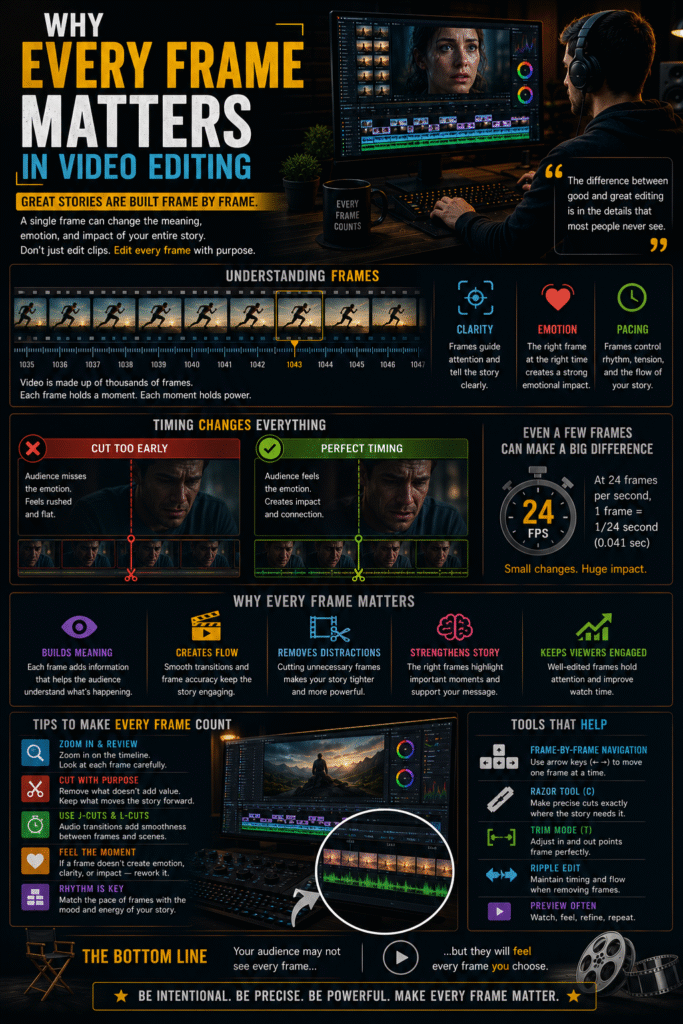
Modern content creation relies heavily on frame-level decisions as well. Whether creating short-form videos, commercials, documentaries, or cinematic content, creators constantly make choices about what stays, what gets removed, and how long each moment should remain visible. These decisions shape the overall experience more than viewers realize.
Another important aspect is storytelling efficiency. Every frame should contribute value. If a shot does not advance the story, create emotion, provide information, or improve engagement, it may weaken the final video. Great editing often involves removing unnecessary frames rather than adding more effects.
In today’s fast-paced digital environment, audience attention is limited. Creators must communicate ideas quickly and effectively. Careful frame selection ensures every second feels meaningful and purposeful, improving viewer retention and overall impact.
Ultimately, great editing is built on thousands of small decisions. While audiences experience videos as a seamless story, editors understand that every powerful moment begins with choosing the right frame at the right time.
🎯 Conclusion
Great storytelling is not created by chance—it is built frame by frame.
Every image on screen contributes to emotion, pacing, clarity, and audience engagement. Small timing adjustments can create dramatic differences in how viewers experience a story.
In the end, audiences may never notice individual frames, but those frames are what make unforgettable moments possible.