
In video editing, transitions are often seen as simple effects used to move from one clip to another. However, transitions are far more than visual decoration. They play a crucial role in controlling flow, maintaining immersion, and shaping how viewers emotionally experience a story. When used correctly, transitions feel natural and invisible. When overused or poorly timed, they can become distracting and reduce the overall impact of the content.
At its core, a transition represents movement from one moment to the next. This movement can be emotional, visual, or narrative. A smooth cut keeps the audience connected to the story without interruption, while a sudden or unnecessary transition can pull attention away from the content itself.
To understand this better, imagine watching a cinematic travel video. One scene shows a person standing on a mountain at sunrise, and the next scene shows a bustling city at night. If the switch between these scenes happens abruptly, the flow may feel harsh and disconnected. But with a carefully timed fade, motion transition, or sound bridge, the change feels smooth and intentional. The audience naturally follows the journey without feeling disrupted.#
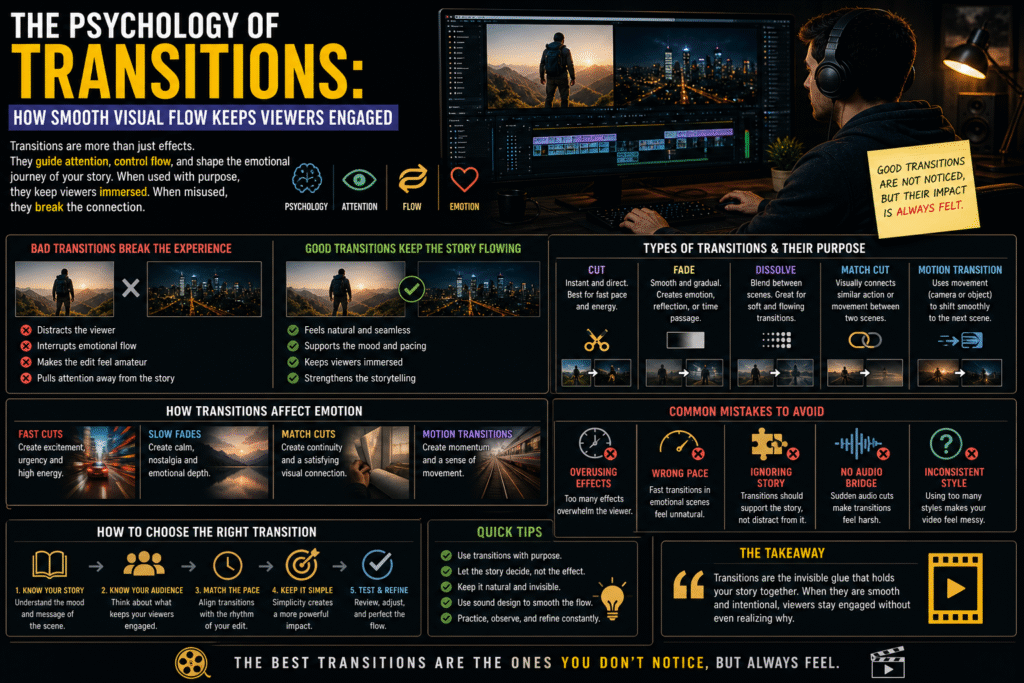
This is where the psychology of transitions becomes important. Human attention responds strongly to movement and continuity. Smooth transitions help the brain process visual information comfortably, making the experience feel more immersive. Abrupt or excessive effects, on the other hand, force viewers to focus on the edit itself rather than the story.
In modern content creation, many beginners make the mistake of overusing flashy transitions in an attempt to make videos look more professional. While these effects may initially appear impressive, too many transitions can overwhelm the viewer and make the content feel chaotic. Professional editing often relies on simplicity—using clean cuts and subtle transitions that support the pacing rather than dominate it.
Different transitions also create different emotional effects. A fast cut can create urgency and energy, while a slow fade may communicate reflection, nostalgia, or the passage of time. Match cuts and motion transitions create visual continuity, making scenes feel connected even when locations or subjects change. These choices influence how viewers emotionally interpret the flow of the video.
Transitions are especially important in short-form content where audience attention is limited. Smooth visual flow helps maintain engagement and prevents viewers from feeling disconnected during quick scene changes. Whether it’s a YouTube vlog, cinematic reel, advertisement, or documentary, transitions shape how naturally the story unfolds.
Another important aspect of transitions is rhythm. Editing is similar to music in many ways—every cut and transition contributes to the overall tempo of the content. Well-timed transitions create a satisfying visual rhythm that keeps the audience engaged from beginning to end.
Ultimately, transitions are not about showing technical skill—they are about guiding the audience through the story in the most seamless way possible. The best transitions are the ones viewers barely notice because they feel completely natural.
In the end, strong editing is not defined by how many effects are used, but by how smoothly the story flows from one moment to the next.