
One of the biggest misconceptions among beginner editors is that adding more effects, transitions, animations, and visual elements automatically makes a video better. In reality, some of the most powerful and professional videos rely on simplicity rather than complexity. Great editing is not about how much you can add—it is about knowing what to leave out.
The principle of “Less Is More” is widely used in filmmaking, advertising, documentaries, and professional content creation. It focuses on removing distractions and allowing the story, message, and emotions to take center stage. Instead of overwhelming viewers with constant visual stimulation, simple editing creates clarity, focus, and impact.
Imagine watching a motivational video where every few seconds a flashy transition, zoom effect, or animation appears. While these effects may initially seem impressive, they quickly become distracting and take attention away from the message. Now compare that to a cleanly edited video with purposeful cuts, smooth pacing, and carefully chosen visuals. The second version often feels more professional because every editing choice serves the story.
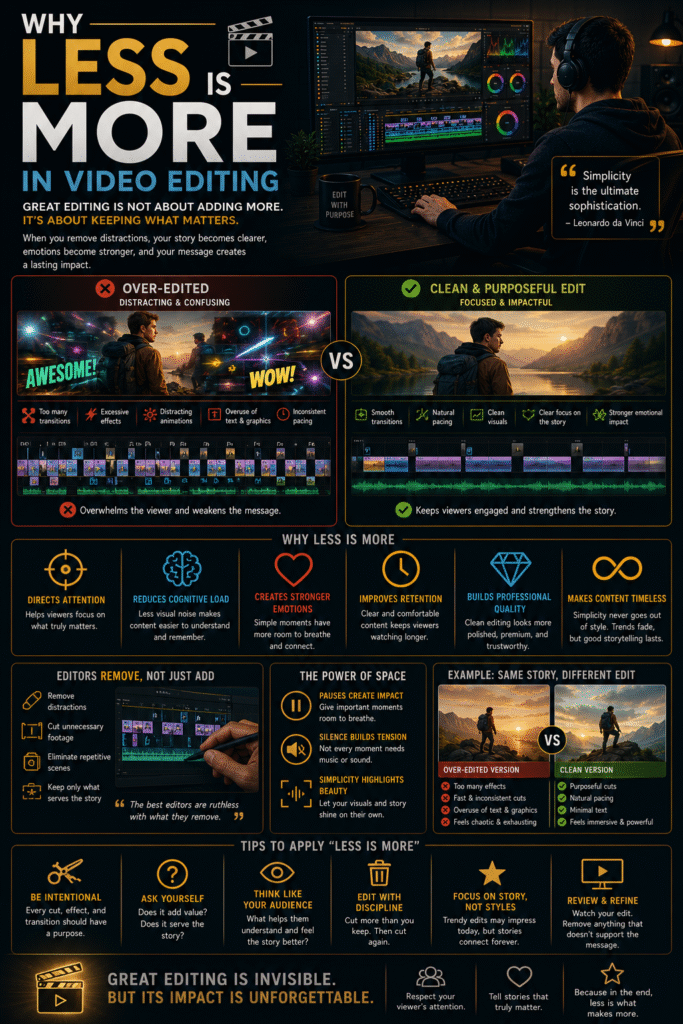
Simplicity also improves audience retention. When viewers are overloaded with effects and unnecessary movement, their attention becomes divided. Clean editing allows audiences to focus on the content itself rather than the editing techniques being used. This creates a more comfortable and immersive viewing experience.
Another reason “Less Is More” works is because it creates stronger emotional moments. Silence can sometimes be more powerful than music. A simple cut can have greater impact than an elaborate transition. A still frame can create more tension than constant movement. Professional editors understand that restraint often creates stronger emotional responses than excess.
In modern content creation, simplicity is especially valuable because audiences consume large amounts of content daily. Videos that communicate clearly and efficiently often perform better than videos filled with unnecessary complexity. Viewers appreciate content that respects their attention and delivers value without distractions.
Color grading, sound design, transitions, and effects should all support the story rather than compete with it. The best editing choices are often the ones viewers barely notice because they feel natural and seamless.
Simplicity also makes content timeless. Trend-heavy editing styles may become outdated quickly, while clean storytelling and purposeful editing remain effective for years. Many of the world’s most memorable films rely on strong storytelling rather than excessive visual effects.
However, simplicity does not mean boring. It means intentional. Every cut, sound, transition, and visual element should have a reason to exist. If an effect does not improve the story, clarify information, or strengthen emotion, it may not be necessary.
Ultimately, great editing is about making viewers feel something—not showing how many tools or effects you can use. Simplicity creates space for stories to breathe and allows emotions to resonate more deeply.
🎯 Conclusion
Professional editing is not measured by how much is added—it is measured by how effectively the story is communicated.
The strongest videos often use fewer effects, cleaner visuals, and more intentional choices. By focusing on clarity, emotion, and purpose, editors create experiences that feel natural, engaging, and memorable.
In the end, less is not a limitation. In great editing, less is often what makes the biggest impact.