
Many people assume that video editing is primarily a technical skill. They focus on learning software shortcuts, transitions, effects, and advanced tools. While technical knowledge is important, the best editors understand something much deeper: editing is not about software—it is about storytelling.
A professional editor does more than arrange clips on a timeline. They shape emotions, guide attention, control pacing, and influence how audiences experience a story. Every cut, transition, sound effect, and visual choice serves a larger purpose. The goal is not simply to make videos look good but to make viewers feel something.
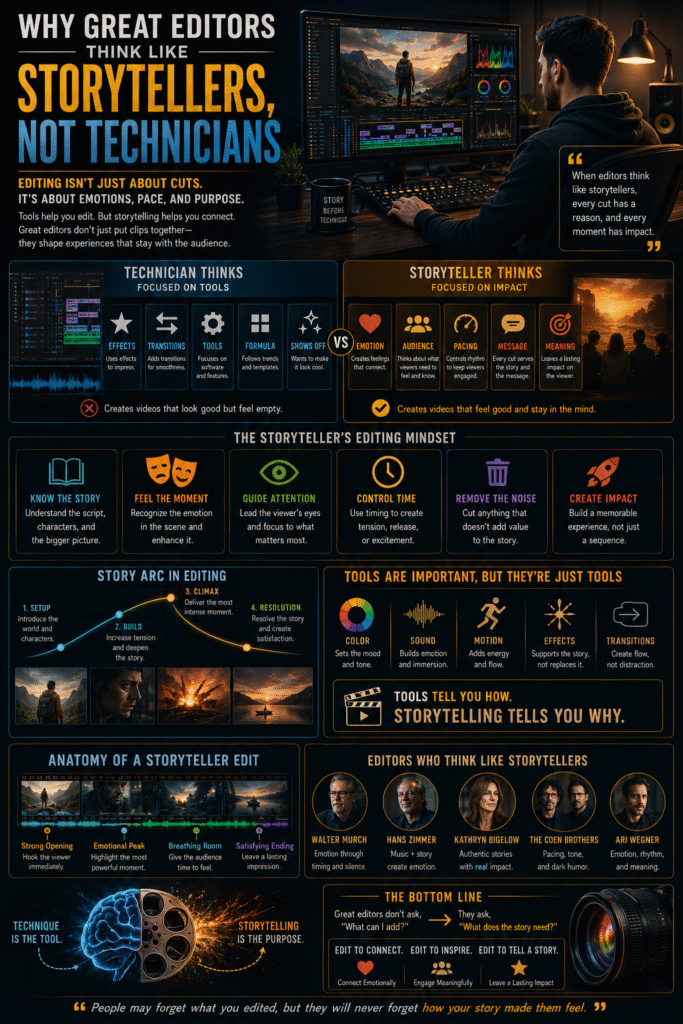
Imagine two editors working with the exact same footage. The first editor focuses mainly on effects and visual tricks. The second editor focuses on emotion, pacing, and narrative flow. Even though both use identical footage, the final results can feel completely different. One video may look impressive, while the other creates a genuine emotional connection. This difference comes from storytelling.
Storytelling begins with understanding the audience. Great editors constantly ask themselves questions such as: What should viewers feel in this moment? What information is most important right now? How can I guide attention naturally? These questions help editors make decisions that strengthen the story rather than distract from it.
One of the most powerful storytelling tools is timing. A reaction shot held for an extra second can create empathy. A faster cut can increase excitement. A moment of silence can build suspense. These small decisions may seem insignificant individually, but together they shape the emotional journey of the audience.
Another important storytelling skill is knowing what to remove. Many beginner editors focus on what they can add, while experienced editors focus on what they can take away. Removing unnecessary scenes, repetitive dialogue, and distracting visuals often strengthens the story more than adding new effects ever could.
Storytelling editors also understand emotional rhythm. Every great story has highs and lows, moments of energy and moments of reflection. Editing helps create this rhythm by controlling pacing, music, visual intensity, and scene structure. Without rhythm, videos can feel monotonous or emotionally flat.
In modern content creation, storytelling has become more important than ever. Audiences are constantly surrounded by content competing for attention. Technical quality alone is no longer enough. People stay engaged when they connect emotionally with a story, message, or experience.
Even in corporate videos, advertisements, documentaries, and social media content, storytelling remains the foundation of engagement. Whether the goal is to educate, inspire, entertain, or persuade, storytelling helps audiences understand and remember the message.
However, thinking like a storyteller does not mean ignoring technical skills. Great editing combines both creativity and technique. Software provides the tools, but storytelling provides the purpose behind every decision.
Ultimately, editing is not about cutting clips—it is about shaping experiences. The best editors understand that their role is not simply to assemble footage but to transform raw moments into meaningful stories.
🎯 Conclusion
Technical skills may help editors create videos, but storytelling is what makes those videos memorable.
Great editors think beyond timelines and software. They think about emotions, audience experience, and narrative impact.
In the end, people rarely remember transitions or effects—but they always remember a story that made them feel something.