
Introduction
Cinema has always evolved with technology. From silent films to digital cameras, CGI, motion capture, and virtual production, every technological advancement has changed the way stories are created and experienced. Today, AI in cinema represents the next major transformation in the filmmaking industry.
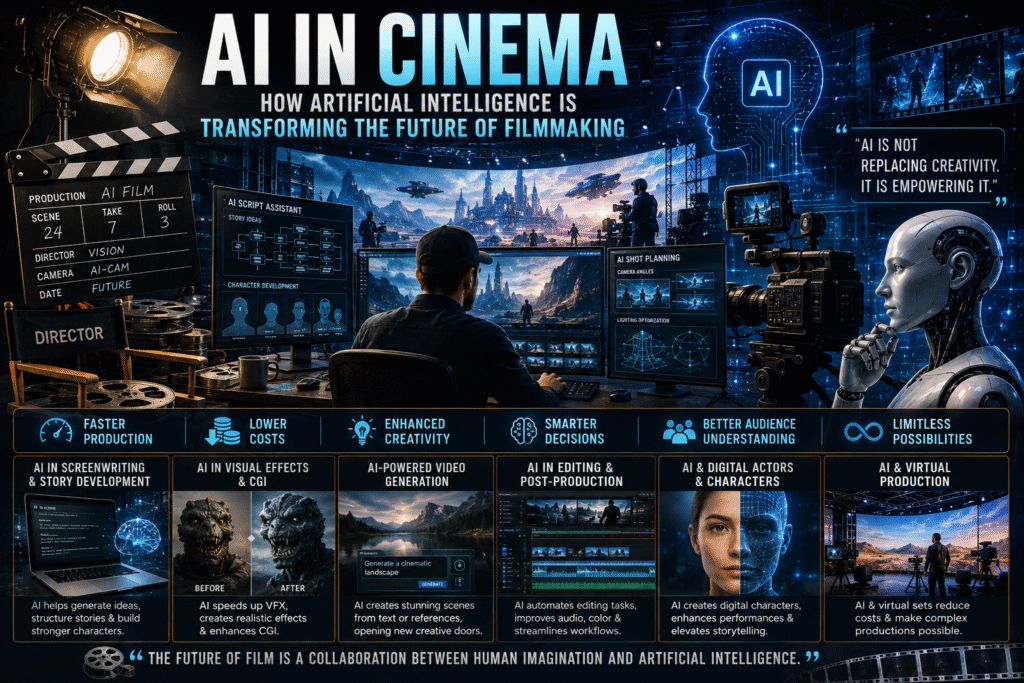
Artificial intelligence is helping filmmakers explore new creative possibilities by assisting with script development, visual effects, editing, animation, and production workflows. Studios and creators are experimenting with AI-powered tools to make filmmaking faster, more efficient, and more innovative.
However, the rise of AI in movies has also created important discussions about creativity, human involvement, copyright, and the future role of filmmakers. While AI can support the filmmaking process, storytelling, emotion, and human imagination remain at the heart of cinema.
What Is AI in Cinema?
AI in cinema refers to the use of artificial intelligence technologies to assist or enhance different stages of filmmaking. AI systems can analyse data, generate content, automate repetitive tasks, and help creators make better artistic decisions.
Artificial intelligence is being used in areas such as:
- Script analysis
- Story development
- Visual effects
- Character creation
- Film editing
- Sound enhancement
- Marketing analysis
- Virtual production
AI does not replace the complete filmmaking process but acts as a creative and technical assistant that helps filmmakers achieve their vision more efficiently.
How Artificial Intelligence Is Changing Movie Production
Movie production involves thousands of tasks, from planning scenes to managing large teams. AI is helping production teams improve efficiency and reduce time-consuming processes.
AI technology can assist with:
- Production planning
- Scheduling
- Location analysis
- Budget predictions
- Camera planning
- Workflow management
For large-scale productions, AI tools can analyse huge amounts of information and help filmmakers make faster decisions.
Virtual production environments powered by AI are also allowing filmmakers to create realistic digital worlds without depending completely on physical sets.
AI in Screenwriting and Story Development
Writing is one of the earliest stages of filmmaking, and AI is beginning to influence how stories are developed.
AI tools can help writers by:
- Analysing screenplay structures
- Suggesting story ideas
- Identifying character patterns
- Improving dialogue flow
- Studying audience preferences
However, storytelling requires human emotions, experiences, and creativity. AI can assist writers, but the imagination and personal perspective of a screenwriter remain essential.
The future of screenwriting may involve collaboration between human writers and AI tools, where technology supports creativity rather than replacing it.
The Role of AI in Visual Effects and CGI
Visual effects have always been one of the most technology-driven areas of filmmaking. AI is now transforming how filmmakers create digital environments, creatures, and realistic effects.
AI-powered VFX can help with:
- Faster rendering
- Digital character creation
- Background generation
- Facial effects
- Scene enhancement
- Image processing
Modern filmmakers can create complex visual experiences more efficiently with AI assistance.
From science-fiction worlds to realistic environments, AI is becoming an important tool for expanding creative possibilities in visual storytelling.
AI-Powered Video Generation and Virtual Production
AI-powered video generation is one of the most discussed developments in modern filmmaking. New AI systems can create realistic video sequences from text descriptions or existing footage.
Virtual production combines AI, computer graphics, and real-time technology to create digital filmmaking environments.
Benefits include:
- Reduced production costs
- Faster scene creation
- Flexible digital locations
- Realistic environments
- Creative experimentation
This technology allows filmmakers to explore ideas that were previously difficult or expensive to produce.
How AI Is Changing Film Editing and Post-Production
Post-production is one of the most time-consuming stages of filmmaking. AI is helping editors and creators complete tasks more efficiently.
AI-powered editing tools can assist with:
- Automatic scene detection
- Colour correction
- Audio improvement
- Video organisation
- Visual enhancement
- Subtitle generation
Editors can focus more on creative decisions while AI handles repetitive technical tasks.
Instead of replacing editors, AI can become a powerful assistant that improves the overall editing process.
The Impact of AI on Actors and Digital Characters
AI is creating new possibilities for character creation and digital performances. Filmmakers can now create realistic digital characters using advanced animation and motion capture technologies.
AI can assist with:
- Digital character creation
- Facial animation
- Performance enhancement
- Age transformation
- Virtual characters
However, the use of AI-generated actors has raised concerns about consent, ownership, and the future of human performers.
Actors bring emotions, experiences, and personality to performances, which remain difficult for technology to fully replicate.
Will AI Replace Filmmakers?
One of the biggest questions in the entertainment industry is whether AI will replace filmmakers.
The answer is unlikely. Filmmaking is not only about technical production; it is about human creativity, emotions, cultural understanding, and storytelling.
AI can help filmmakers by:
- Improving workflows
- Reducing production time
- Generating ideas
- Supporting creative decisions
However, directors, writers, actors, and artists provide the human perspective that makes stories meaningful.
The future will likely involve collaboration between humans and AI rather than complete replacement.
Benefits of Artificial Intelligence in Cinema
AI provides several advantages for modern filmmaking.
Faster Production
AI can automate repetitive tasks and reduce production time.
Cost Reduction
Smaller teams can create high-quality content with AI assistance.
Creative Exploration
Filmmakers can experiment with new ideas and visual styles.
Improved Efficiency
AI helps organise workflows and analyse large amounts of information.
Better Audience Understanding
AI analytics can help studios understand viewer preferences and improve marketing strategies.
Challenges and Ethical Concerns of AI Movies
Despite its benefits, AI in cinema creates several challenges.
Copyright Issues
Questions remain about ownership of AI-generated content.
Impact on Jobs
Artists and industry professionals are concerned about how AI may affect creative careers.
Authenticity Concerns
Audiences may question whether AI-generated performances and stories have genuine emotional value.
Misuse of Technology
AI-generated content can create problems related to misinformation and unauthorised digital replicas.
The film industry must establish ethical guidelines to ensure responsible use of AI technology.
The Future of AI-Powered Filmmaking
The future of cinema will likely involve deeper collaboration between filmmakers and artificial intelligence.
Future developments may include:
- AI-assisted filmmaking tools
- Real-time digital environments
- Personalised movie experiences
- Advanced virtual characters
- Automated production workflows
AI will continue to change how movies are created, but human creativity will remain the foundation of storytelling.
The most successful filmmakers of the future will be those who combine artistic vision with technological innovation.
Conclusion
Artificial intelligence is transforming cinema by introducing new tools that improve creativity, efficiency, and production possibilities. From screenplay development and visual effects to editing and virtual production, AI is becoming an important part of modern filmmaking.
However, movies are built on emotions, imagination, and human experiences. AI can enhance the filmmaking process, but the heart of cinema will always come from human storytellers.
The future of filmmaking will not be humans versus AI — it will be humans working together with AI to create new forms of cinematic experiences.
Primary Keywords
- AI in Cinema
- Artificial Intelligence in Filmmaking
- AI Movie Technology
- Future of Filmmaking
- AI Generated Movies
- AI Visual Effects
- AI Film Production
Secondary Keywords
- How AI is changing movies
- Artificial intelligence and Hollywood
- AI filmmaking tools
- Future movie technology
- AI in VFX
- AI scriptwriting
- Virtual production technology
- AI movie editing
LSI Keywords
- Machine learning
- Generative AI
- CGI
- Visual effects
- Film studios
- Directors
- Screenwriters
- Digital characters
- Motion capture
- Virtual actors
- Post-production
- Animation technology
- Creative technology
Internal Links
Add links to:
- The Evolution of Visual Effects (VFX): How Technology Transformed Modern Cinema
- The Magic of Cinematography: How Camera Angles and Lighting Shape Every Movie
- The Art of Film Editing: The Invisible Storyteller
- The Role of Sound Design: How Audio Creates Cinematic Experiences
- Film Production Process: How Movies Are Made From Script to Screen
- The Future of Streaming Platforms
External Links
Use:
Variety AI News
https://variety.com/
OpenAI
https://openai.com/
Academy of Motion Picture Arts and Sciences
https://www.oscars.org/
Adobe Creative Cloud
https://www.adobe.com/
NVIDIA AI
https://www.nvidia.com/