
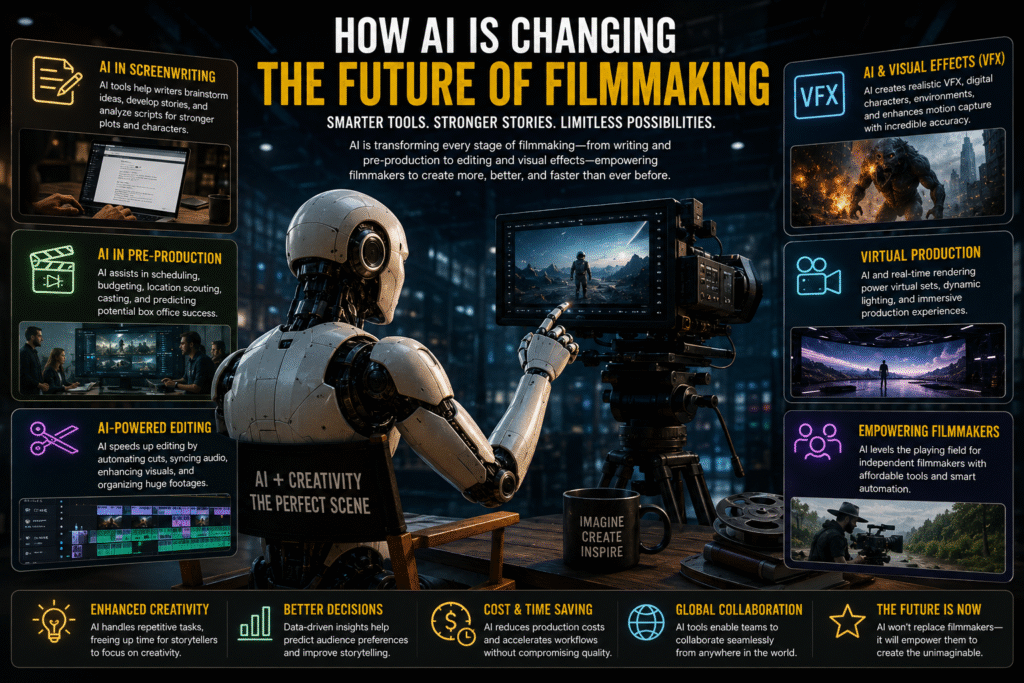
Artificial intelligence is rapidly transforming the film industry, changing how movies are planned, produced, edited, marketed, and distributed. What once seemed like science fiction has become an essential part of modern filmmaking. From helping writers generate story ideas to enhancing visual effects and streamlining post-production, AI is becoming a valuable creative assistant rather than a replacement for human talent.
Filmmakers around the world are using AI-powered tools to speed up production, improve editing, create realistic visual effects, restore old films, generate subtitles, and even analyze audience preferences before a movie is released. These innovations allow production teams to reduce costs, save time, and focus more on creativity and storytelling.
The rise of virtual production has further expanded AI’s influence in cinema. Combined with advanced computer graphics, motion capture, and machine learning, filmmakers can now create realistic environments, digital characters, and complex action sequences with greater efficiency than ever before. Independent filmmakers also benefit from affordable AI tools that make professional-quality filmmaking accessible without massive production budgets.
Despite these technological advancements, AI cannot replace the emotional depth, imagination, and creative vision that human filmmakers bring to storytelling. Great movies continue to rely on compelling characters, meaningful narratives, and artistic direction. Instead, artificial intelligence acts as a powerful tool that enhances creativity, automates repetitive tasks, and supports filmmakers throughout the production process.
As technology continues to evolve, AI will play an even greater role in shaping the future of cinema. Understanding how filmmakers use artificial intelligence today offers valuable insight into where the film industry is headed and how audiences will experience movies in the years to come.
What Is AI in Filmmaking?
Artificial intelligence (AI) in filmmaking refers to the use of intelligent software and machine learning technologies to support different stages of movie production. From developing scripts and planning scenes to editing videos and creating realistic visual effects, AI helps filmmakers work more efficiently while improving the overall quality of their productions. Rather than replacing creativity, AI serves as a powerful tool that allows directors, editors, writers, and production teams to focus on storytelling and artistic expression. As technology continues to evolve, AI is becoming an essential part of modern filmmaking, enabling both major studios and independent creators to produce high-quality content with greater speed and precision.
How AI Is Transforming Film Production
AI is changing the way movies are produced by automating repetitive tasks and improving decision-making throughout the production process. Production teams now use AI to organize schedules, analyze scripts, manage budgets, and optimize shooting plans. Machine learning algorithms can predict production challenges and recommend efficient workflows, helping filmmakers save both time and resources. These technological advancements allow production teams to spend more time focusing on creative aspects while AI handles complex planning and data analysis behind the scenes.
AI in Screenwriting and Story Development
Screenwriters are increasingly using AI-powered tools to generate story ideas, organize plot structures, and refine dialogue. AI can analyze thousands of successful screenplays to identify storytelling patterns, character development techniques, and pacing strategies. While AI can assist with brainstorming and script organization, human writers remain responsible for creating emotional depth, originality, and compelling narratives. The combination of AI assistance and human creativity enables screenwriters to develop stronger stories while maintaining their unique storytelling style.
AI-Powered Video Editing
Video editing has become faster and more efficient with the help of artificial intelligence. Modern editing software uses AI to automatically organize footage, detect important scenes, remove background noise, improve color correction, and generate subtitles. Editors can quickly identify the best takes and apply advanced editing techniques with minimal manual effort. By reducing time spent on repetitive editing tasks, AI allows editors to focus on creating smooth transitions, enhancing emotional impact, and delivering polished cinematic experiences.
AI and Visual Effects (VFX)
Artificial intelligence has revolutionized visual effects by making complex CGI and digital environments easier to create. AI assists artists in generating realistic animations, enhancing facial expressions, improving motion capture, and creating lifelike digital characters. Advanced AI tools can also remove unwanted objects, upscale video quality, and automate visual enhancements that once required extensive manual work. These innovations enable filmmakers to produce stunning visual effects while reducing production costs and shortening post-production timelines.
Virtual Production with Artificial Intelligence
Virtual production combines AI, real-time rendering, and advanced computer graphics to create immersive filming environments. Instead of relying solely on physical sets, filmmakers can shoot scenes against massive LED screens displaying realistic digital backgrounds. AI helps synchronize camera movements, lighting, and visual effects in real time, allowing directors to visualize the final scene during filming. This technology has become increasingly popular because it offers greater flexibility, reduces location expenses, and streamlines production workflows.
How AI Helps Independent Filmmakers
Independent filmmakers often face limited budgets and smaller production teams. AI provides affordable solutions that help them produce professional-quality films without requiring expensive equipment or large crews. AI-powered editing software, automated subtitle generation, script analysis tools, and visual enhancement applications allow independent creators to compete with larger studios. These accessible technologies encourage creative experimentation and provide new opportunities for emerging filmmakers to share their stories with global audiences.
Challenges of Using AI in Filmmaking
Although AI offers numerous advantages, it also presents important challenges for the film industry. Many professionals express concerns about copyright, originality, data privacy, and the potential impact of automation on creative jobs. AI-generated content still requires human supervision to ensure accuracy, emotional authenticity, and artistic quality. Filmmakers must also address ethical questions surrounding ownership, transparency, and responsible use of artificial intelligence. Maintaining the balance between technological innovation and human creativity remains essential for the future of filmmaking.
The Future of AI in the Film Industry
Artificial intelligence will continue to play a growing role in filmmaking as technology becomes more advanced. Future AI systems may assist with personalized storytelling, real-time language translation, virtual actors, intelligent production planning, and highly realistic digital environments. However, audiences will always value authentic stories created by human imagination and emotion. Rather than replacing filmmakers, AI will continue serving as a collaborative tool that enhances creativity, improves production efficiency, and expands the possibilities of cinematic storytelling.
Conclusion
Artificial intelligence is reshaping every stage of filmmaking, from script development and production planning to editing, visual effects, and movie distribution. Its ability to automate complex tasks, reduce production costs, and improve creative workflows has made AI an invaluable resource for filmmakers around the world. At the same time, successful movies continue to depend on human creativity, emotional storytelling, and artistic vision. As the film industry embraces new technologies, AI will remain a powerful partner that supports filmmakers while allowing them to focus on what matters most—telling unforgettable stories that connect with audiences across the globe.
Internal Links
- How Screenwriters Turn Ideas into Blockbuster Movies
- The Art of Film Editing: The Invisible Storyteller
- The Power of Documentary Filmmaking in the Digital Era
- The Rise of Independent Cinema in the Digital Age