
Film sound design is an essential part of modern filmmaking that shapes how audiences experience a story. While cinematography determines what viewers see, sound determines much of what they hear, feel and anticipate throughout a scene.
From dialogue and background ambience to Foley, sound effects and music, every audio element has a purpose. A carefully designed soundtrack can establish a location, strengthen a character’s emotions, create tension and make fictional environments feel believable.
The work begins with the sounds recorded during production and continues through post-production, where editors and sound designers refine, create and combine different elements into the final soundtrack.
What Is Film Sound Design?
Film sound design is the creative and technical process of developing the audio environment of a film.
It involves selecting, recording, editing, creating and arranging sounds to support the visual storytelling.
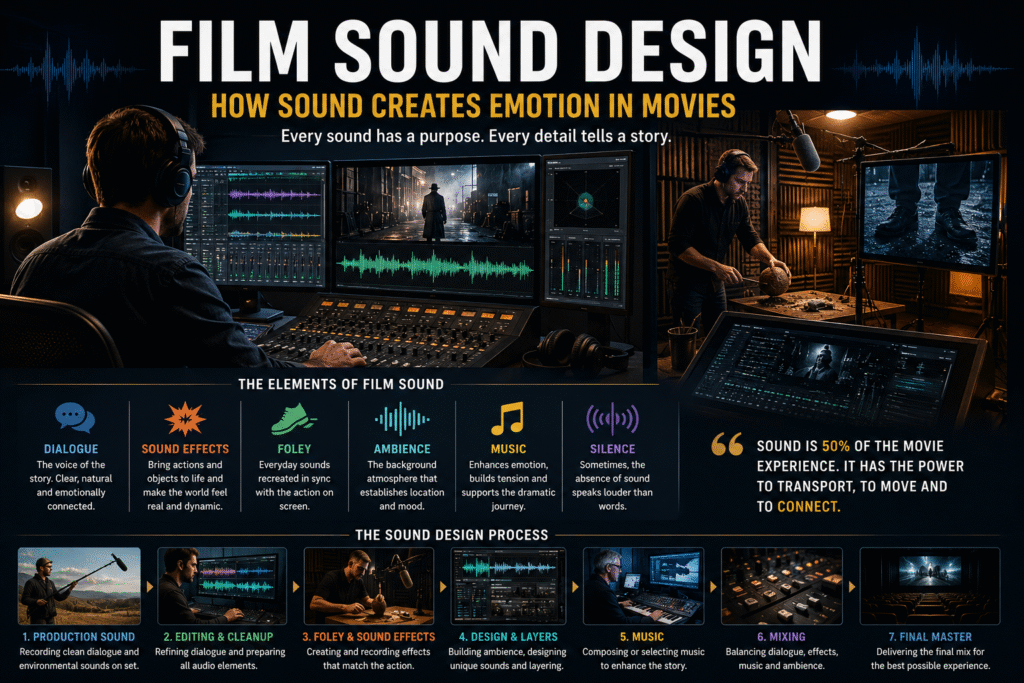
A film soundtrack can contain:
- Dialogue
- Sound effects
- Foley
- Ambient sound
- Music
- Room tone
- Voice-over
- Special effects
- Silence
The purpose is not simply to add more sound to a scene. The sound should work with the image and contribute to the story, atmosphere and emotional direction.
Why Is Film Sound Design Important?
Sound has a direct influence on the way audiences interpret a scene.
A well-planned film sound design approach can:
- Establish the setting
- Create atmosphere
- Build suspense
- Strengthen emotional moments
- Support character development
- Direct audience attention
- Improve realism
- Connect different scenes
- Enhance visual effects
- Create a sense of immersion
For example, a quiet hallway can become more suspenseful when subtle footsteps or distant environmental sounds are introduced. Likewise, removing sound at the right moment can make an emotional or dramatic scene more powerful.
What Does a Film Sound Designer Do?
A film sound designer develops the overall sonic character of a movie.
The sound designer works closely with the director, editor and other members of the post-production team to determine how the film should sound.
Depending on the production, the sound team may include:
- Sound designer
- Production sound mixer
- Dialogue editor
- Foley artist
- Sound effects editor
- Supervising sound editor
- Re-recording mixer
- Composer
Each professional contributes to a different part of the soundtrack, while the overall objective is to create a coherent audio experience.
The Film Sound Design Process
The film sound design process begins with production recording and continues through detailed post-production work.
Recording Production Sound
Production sound is captured while the scenes are being filmed.
The primary focus is usually clear dialogue, but the sound team may also record useful environmental sounds and other elements that can contribute to the final soundtrack.
Common equipment includes:
- Boom microphones
- Wireless microphones
- Digital audio recorders
- Headphones
- Monitoring systems
The sound team must also manage unwanted noise from traffic, wind, machinery and other environmental sources.
Editing Dialogue
After production, recorded dialogue is reviewed and prepared for the final soundtrack.
The dialogue editor may remove unwanted noise, correct technical issues and select the strongest recordings.
When production dialogue cannot be used effectively, additional dialogue may sometimes be recorded during post-production.
The objective is to preserve the actor’s performance while delivering clear and natural dialogue.
Creating Sound Effects
Sound effects give physical actions and objects an audible presence.
They can include:
- Doors opening
- Cars
- Footsteps
- Phones
- Machinery
- Weather
- Breaking objects
- Explosions
- Environmental activity
Some effects are recorded specifically for the production, while others are selected from professional sound libraries and adapted to suit the scene.
Foley Recording
Foley is the process of recreating everyday sounds that correspond with movements visible on screen.
A Foley artist may recreate:
- Footsteps
- Clothing movement
- Objects being handled
- Doors opening
- Eating and drinking
- Physical movements
These sounds are often subtle, but they provide important detail and help make the action feel natural.
Building Ambient Sound
Ambient sound establishes the background atmosphere of a location.
For example, a forest may contain:
- Wind
- Birds
- Insects
- Leaves
- Distant environmental sounds
A city scene may require:
- Traffic
- Pedestrians
- Vehicles
- Construction
- Distant conversations
These layers create continuity between shots and make locations feel more convincing.
Designing Special Sound Effects
Some sounds have to be created because they do not exist naturally.
This is particularly common in:
- Science fiction
- Fantasy
- Horror
- Action
- Superhero films
A fictional creature, futuristic machine or imaginary weapon may require an entirely original sound.
Sound designers can combine recordings, synthesis and digital processing to develop these effects.
Adding Music
Music can play an important role in shaping the emotional direction of a film.
A composer may create an original score specifically for the production.
Music can:
- Establish mood
- Increase tension
- Support emotional scenes
- Introduce characters
- Create anticipation
- Connect different parts of the story
Music is most effective when it supports the scene without overpowering dialogue or other important sounds.
Mixing the Soundtrack
Once the individual elements have been created and edited, they need to be balanced.
Sound mixing brings together:
- Dialogue
- Music
- Foley
- Sound effects
- Ambience
The mixer determines the relative volume and placement of these elements so that the soundtrack works as a unified whole.
Final Sound Mastering
The completed soundtrack is prepared according to the technical requirements of the intended release.
Different versions may be required for:
- Cinemas
- Streaming services
- Television
- Festivals
- Digital platforms
Quality control ensures that the final audio is clear, balanced and technically suitable for delivery.
Types of Sound Used in Film
Dialogue
Dialogue communicates what characters say and is usually one of the most important elements of the soundtrack.
Clear dialogue helps audiences understand both the information and the performance.
Sound Effects
Sound effects represent actions, objects and events within a scene.
They can be realistic or highly stylised depending on the creative requirements.
Foley
Foley recreates physical sounds that correspond with actions on screen.
It adds realism and detail to the soundtrack.
Ambient Sound
Ambient sound creates the background atmosphere of a location.
It helps connect shots and maintain a consistent sense of place.
Film Music
Music supports the emotional and dramatic structure of the film.
It can create anticipation, tension, intimacy or excitement depending on how it is used.
Diegetic Sound
Diegetic sound comes from within the world of the story.
Examples include:
- A character speaking
- A television playing
- A telephone ringing
- A vehicle engine
The characters can generally hear these sounds.
Non-Diegetic Sound
Non-diegetic sound exists outside the story world.
Examples include:
- Film scores
- Certain forms of narration
- Some dramatic sound elements
These sounds are intended primarily for the audience.
What Is Foley in Film?
Foley is the specialised recording of physical sounds that synchronise with actions in a film.
A Foley artist watches the scene and recreates sounds such as footsteps, clothing movement and objects being handled.
The process can involve ordinary objects being used in creative ways to produce convincing sounds.
Foley is particularly useful when the original production recording does not provide sufficient detail or clarity.
How Sound Effects Are Created for Movies
Creating sound effects can involve recording real-world sounds and transforming them into something appropriate for the film.
A single fictional sound may be constructed from several layers.
For example, the sound of a fictional creature could combine:
- Animal recordings
- Human vocal sounds
- Environmental recordings
- Mechanical noises
- Digital processing
The layers are then edited and mixed until the desired result is achieved.
How Film Sound Creates Emotion
Sound can influence an audience’s emotional response without explicitly explaining what they should feel.
A deep rumble may create uneasiness.
A sudden silence may increase anticipation.
A musical theme can establish emotional recognition.
An unexpected sound can create surprise or fear.
These techniques allow sound to communicate information and emotion alongside the visuals.
Film Sound Design and Visual Storytelling
Sound and image are closely connected.
A character may look toward something outside the frame while the audience hears an approaching sound. The sound provides information before the camera reveals its source.
Similarly, a change in background ambience can indicate that a character has entered a different environment.
This relationship between sound and image allows filmmakers to expand the story beyond what is directly visible.
Film Sound Design and Film Editing
Editing and sound design influence each other throughout post-production.
A cut may be supported by:
- Dialogue
- Music
- Sound effects
- Silence
- Ambient sound
Audio can also continue across a visual cut, helping create a smoother transition between scenes.
In some cases, an audio cue can begin before the corresponding image appears. This technique can prepare the audience for what comes next and create a more natural transition.
Film Sound Design and Cinematography
Cinematography determines how a story is photographed, while sound adds another dimension to the same environment.
A wide shot of a remote landscape may become much more convincing when combined with wind, distant wildlife and environmental ambience.
The image establishes the visual setting, while sound gives that setting depth.
This is why film sound design should be considered alongside cinematography rather than as an entirely separate creative process.
Film Sound Design and Visual Effects
Visual effects frequently require specially designed audio.
Digital creatures, futuristic vehicles and large-scale destruction may have no real-world sound to record.
Sound designers therefore create audio that gives these visual elements weight and presence.
The right combination of visual effects and sound can make computer-generated elements feel more convincing and integrated into the scene.
What Is Film Sound Mixing?
Film sound mixing is the process of balancing the different audio elements in the finished soundtrack.
The mixer considers:
- Dialogue levels
- Music levels
- Sound effects
- Foley
- Ambient sound
- Spatial placement
- Dynamic range
The goal is to ensure that important sounds remain clear while maintaining the intended emotional and dramatic balance.
What Is the Difference Between Sound Editing and Sound Design?
The two terms are closely related but refer to different areas of work.
Sound editing generally focuses on selecting, organising, cleaning and preparing audio elements.
Sound design involves the broader creative process of determining what the film should sound like and creating or shaping the sounds needed to achieve that result.
On many productions, these responsibilities overlap between different members of the sound department.
Film Sound Design for Independent Filmmakers
Independent filmmakers often work with smaller teams and tighter budgets.
This makes careful sound planning particularly important.
Independent productions should pay attention to:
- Recording clean dialogue
- Controlling location noise
- Capturing room tone
- Organising audio files
- Backing up recordings
- Planning Foley requirements
- Allowing enough time for post-production sound
Strong production sound can save significant time during post-production.
Common Film Sound Problems
Unclear Dialogue
Background noise or poor microphone placement can make dialogue difficult to understand.
Inconsistent Audio Levels
Large differences in volume between shots can distract the audience.
Missing Ambient Sound
Without background atmosphere, scenes can feel unnaturally empty.
Excessive Music
Music that is too prominent can compete with dialogue and important sound effects.
Poor Sound Continuity
Sudden changes in background sound can make cuts between shots noticeable.
Overuse of Sound Effects
Too many effects can make a scene feel artificial rather than immersive.
How Sound Changes the Audience Experience
Sound continuously influences the way an audience experiences a film.
A carefully constructed soundtrack can help viewers:
- Feel tension
- Understand a location
- Notice important details
- Connect with characters
- Anticipate events
- Experience emotional moments more strongly
Sound can also provide information that the camera does not show.
This makes it one of the most effective storytelling tools available to filmmakers.
Film Sound Design and Silence
Silence is also a deliberate sound-design choice.
Removing or reducing sound at the right moment can create:
- Suspense
- Isolation
- Shock
- Emotional weight
- Anticipation
If every scene is filled with music and effects, silence loses its impact.
Knowing when to leave space in the soundtrack can therefore be just as important as adding sound.
From Film Sound Design to Final Film Delivery
Once the soundtrack has been edited, designed and mixed, it becomes part of the completed film.
The project may then proceed through:
- Colour grading
- Visual effects
- Quality control
- Mastering
- Subtitle preparation
- Distribution
The final audio must meet the technical requirements of the intended release format.
Whether a film is released in cinemas, on streaming platforms or through festivals, consistent and technically accurate sound remains essential.
Final Thoughts
Film sound design gives a movie its sonic identity.
Dialogue communicates the words of the characters, while Foley, sound effects, ambience and music create the world around them. Together, these elements can make a scene feel realistic, emotional, tense or memorable.
Effective sound design does not always call attention to itself. Often, the best soundtrack is one that feels natural and allows the audience to remain fully immersed in the story.
From production recording to dialogue editing, Foley, sound effects, music and final mixing, every stage contributes to the finished cinematic experience.
Sound may not be visible on screen, but it remains one of the fundamental elements of filmmaking.