
In filmmaking and content creation, the most powerful editing is often the one that goes completely unnoticed. While flashy transitions and dramatic effects can grab attention, they are not what makes a story truly engaging. The real strength of editing lies in its ability to remain invisible, guiding the audience smoothly from one moment to the next without drawing attention to itself. When editing is done well, viewers are not thinking about cuts or transitions—they are simply experiencing the story.
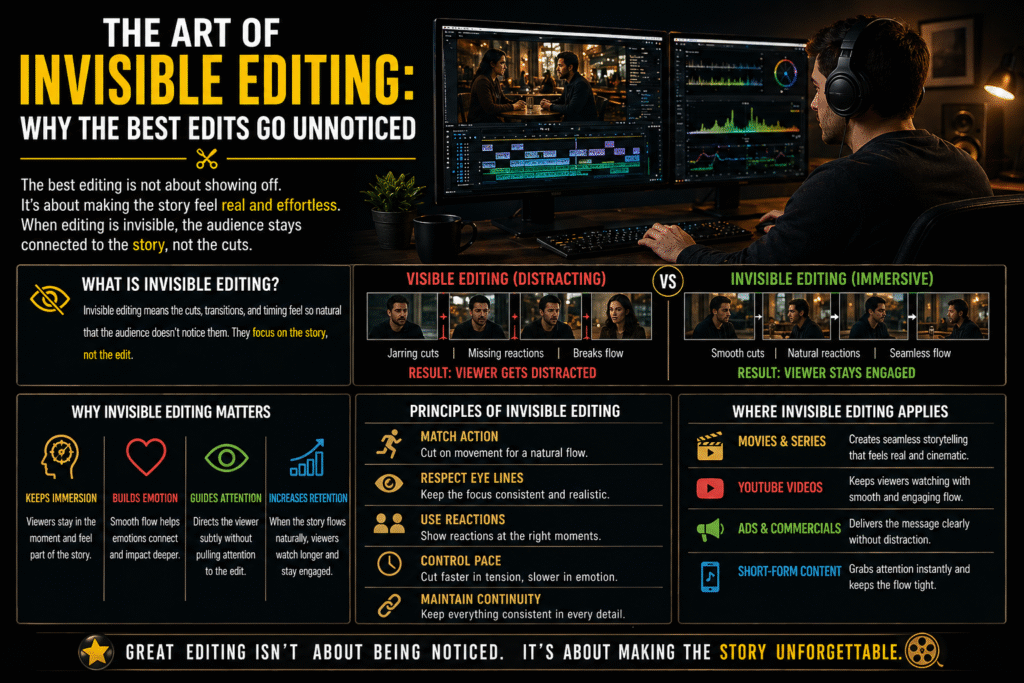
Invisible editing is built on the idea of immersion. The audience should feel like they are part of the scene, not watching something that has been assembled. This means every cut, every transition, and every timing decision must feel natural. If a cut happens too early or too late, it becomes noticeable. If a reaction shot is missing, the flow feels incomplete. But when everything is placed perfectly, the story unfolds effortlessly, and the viewer remains fully engaged without distraction.
To understand this, consider a simple conversation scene between two people. The scene may be filmed using multiple camera angles and several takes. In its raw form, it is fragmented and inconsistent. However, through editing, these pieces are carefully arranged to create a smooth and continuous interaction. The editor ensures that eye-lines match, reactions appear at the right moments, and dialogue flows naturally. When done correctly, the audience does not notice any cuts—they only see a realistic conversation.
This subtle control is what makes invisible editing so powerful. It directs the viewer’s attention without them realizing it. By choosing when to cut and what to show, the editor decides what the audience focuses on and how they interpret each moment. Even though the viewer is unaware of these decisions, they are constantly being guided through the story.
In contrast, poor editing immediately breaks immersion. Abrupt cuts, inconsistent timing, or unnecessary transitions can distract the viewer and pull them out of the experience. Instead of following the story, they start noticing the editing itself. This not only disrupts engagement but also reduces the emotional impact of the scene.
In today’s digital content landscape, invisible editing is just as important as it is in cinema. Whether it is a YouTube video, a short-form reel, or an advertisement, smooth and natural editing keeps viewers watching. Clean cuts, balanced pacing, and seamless flow make content feel professional and easy to follow. Even simple videos can feel high-quality when the editing is subtle and well-executed.
Ultimately, invisible editing is about restraint and precision. It is not about showing technical skill through flashy effects, but about knowing when to step back and let the story lead. The best editors understand that their role is not to be seen, but to support the narrative in the most effective way possible.
In the end, great editing is not something the audience notices—it is something they feel. It allows the story to exist without interruption, creating an experience that feels natural, engaging, and complete.