
Introduction
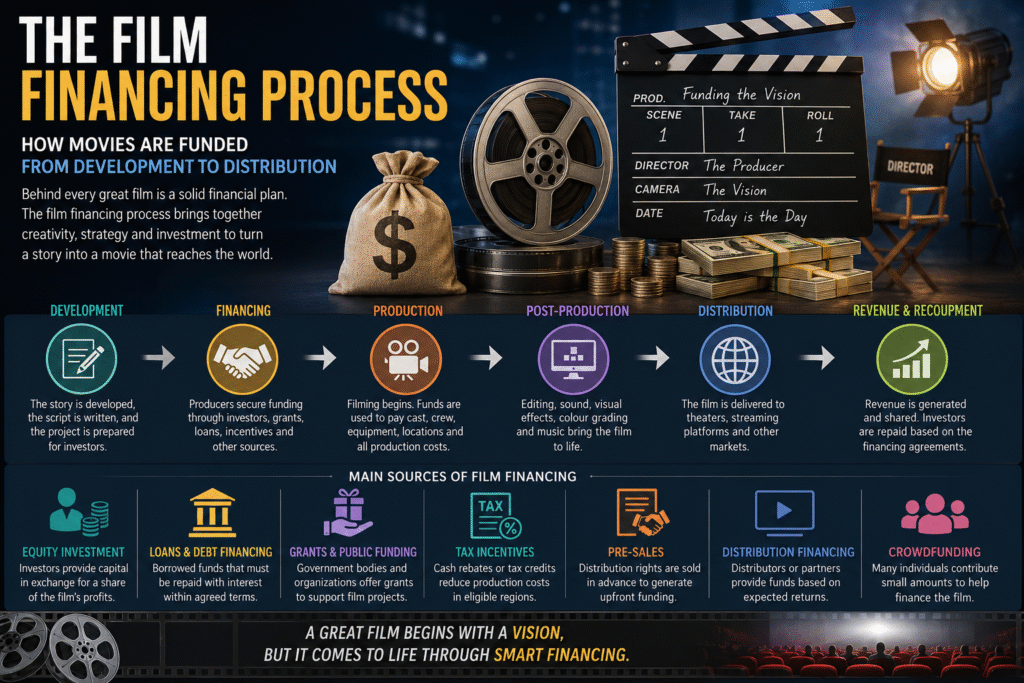
The film financing process is an essential part of turning a movie idea into a completed production. Before cameras begin rolling, producers need to determine the project’s budget, identify potential funding sources and establish how the production will be financially supported through development, filming, post-production and distribution.
Film financing can involve several different sources, depending on the scale, genre, budget and commercial expectations of a project. Producers may work with private investors, production companies, lenders, public funding bodies, tax incentive programmes, distributors or other financial partners.
For independent filmmakers, understanding how film financing works is particularly important. A well-prepared financing strategy can help producers determine how much money is required, where it can come from and how the investment may eventually be recovered.
What Is the Film Financing Process?
Film financing refers to the process of raising, structuring and managing the funds required to develop, produce and complete a film.
The financing process can begin before cameras are used. Development expenses may include:
- Screenwriting
- Story development
- Research
- Legal work
- Casting
- Location research
- Producer fees
- Early production planning
Once a project moves toward production, the financial requirements become much larger. Production costs may include cast and crew salaries, equipment, locations, transportation, accommodation, sets, costumes, insurance and other operational expenses.
Financing can continue through post-production, where money may be required for editing, sound design, visual effects, colour grading, music and final delivery.
Why Is the Film Financing Process Important?
Film financing determines whether a project can move from an idea to an actual production.
A film budget needs to account for both creative requirements and practical expenses. Without adequate funding, producers may need to reduce the scope of the project, delay production or reconsider certain creative decisions.
Effective financing helps filmmakers:
- Establish a realistic production budget
- Secure necessary resources
- Pay cast and crew
- Plan production properly
- Complete post-production
- Prepare the film for distribution
- Manage financial risks
- Determine how investments may be recovered
Financing is therefore not simply about finding money. It is about building a financial structure that supports the entire filmmaking process.
How Does the Film Financing Process Work?
The film financing process generally begins with determining the project’s financial requirements.
Producers first develop an estimated budget based on the screenplay, production requirements and intended scale of the film.
The financing plan may then identify potential sources of funding and determine how different sources can work together.
For example, an independent film might combine private investment with a grant, a tax incentive and a distribution agreement.
The exact structure varies from project to project.
Main Sources of Film Funding
There is no single method for financing every movie. Different projects use different combinations of funding.
Equity Investment
Equity financing involves investors providing capital in exchange for a financial interest in the project.
An investor may expect to receive a return if the film generates revenue after eligible costs and contractual obligations have been addressed.
Equity investors generally need to understand the risks involved because film revenue is not guaranteed.
Loans and Debt Financing
Some productions use loans or other forms of debt financing.
Unlike equity investment, debt normally involves an obligation to repay the borrowed funds according to agreed terms.
The availability and structure of film loans can depend on the project’s budget, collateral, contracts, distribution arrangements and financial strength.
Grants and Public Funding
Some films may qualify for grants or public funding programmes designed to support filmmaking and cultural production.
These programmes can have specific eligibility requirements and may be available only to certain types of filmmakers, projects or productions.
Grants can be particularly valuable for independent filmmakers because they may reduce the amount of private capital required.
Tax Incentives
Some territories provide tax incentives to encourage film and television production.
These incentives can reduce certain production costs or provide financial benefits when a production meets the relevant requirements.
Eligibility can depend on factors such as:
- Location
- Production expenditure
- Local employment
- Creative requirements
- Production company structure
Because tax rules vary between jurisdictions, producers need professional financial and legal advice when planning around incentives.
Pre-Sales
A pre-sale occurs when distribution rights are negotiated before the film has been completed.
The value of a pre-sale may depend on factors such as the film’s cast, genre, market, territory and commercial prospects.
Pre-sales can sometimes form part of a larger financing structure.
Distribution Financing
A distributor or other commercial partner may contribute to financing when there is a strong expectation that the completed film can generate revenue in a particular market.
Distribution agreements can therefore play a role in the overall financing strategy.
Crowdfunding
Crowdfunding allows filmmakers to raise smaller contributions from a larger number of supporters through online campaigns.
It can be particularly useful for smaller productions, short films and projects with an established audience or strong community interest.
Crowdfunding can also help demonstrate audience interest, although raising money through a campaign does not guarantee commercial success.
How Independent Films Are Financed
Independent films often operate with smaller budgets and fewer financial resources than major studio productions.
Independent producers may therefore need to combine several funding sources.
A financing structure might include:
- Private investors
- Production companies
- Grants
- Tax incentives
- Crowdfunding
- Pre-sales
- Distribution agreements
- Personal or company capital
Independent filmmakers also need to consider the financial risk associated with each source.
A lower-budget production does not automatically mean a simpler financing process. Producers still need accurate budgets, contracts, financial records and a realistic plan for completing and releasing the film.
Creating a Film Finance Plan
A film finance plan explains how a production intends to raisePrimary Keywords the money required for the project.
It should normally begin with a realistic production budget.
The plan can identify:
- Total production cost
- Development expenses
- Financing sources
- Amount expected from each source
- Timing of funding
- Production expenses
- Post-production expenses
- Contingency funds
- Distribution and delivery costs
A clear finance plan allows potential investors and partners to understand how the project is expected to be funded.
Preparing a Film Investment Proposal
When approaching investors, producers need to present the project professionally.
A film investment proposal may include:
- Film synopsis
- Screenplay information
- Director’s vision
- Producer information
- Cast details
- Production plan
- Budget
- Financing structure
- Distribution strategy
- Target audience
- Market information
- Revenue strategy
- Investment terms
Investors need enough information to understand both the creative opportunity and the financial risks.
A professional presentation should be realistic rather than making guaranteed claims about revenue or profitability.
What Do Film Investors Look For?
Different investors have different priorities, but several factors commonly influence investment decisions.
The Story
A strong concept can help demonstrate the project’s creative potential.
The Team
Experienced producers, directors and key creative professionals can increase confidence in the project’s ability to reach completion.
The Budget
Investors need to understand how much money is required and how it will be used.
The Audience
A clearly defined target audience can help demonstrate the potential market for the film.
Distribution Strategy
Investors may want to know how the completed film is expected to reach audiences.
Financial Structure
The financing agreement should clearly explain investment, recoupment, revenue participation and other relevant terms.
Film Budgeting and Production Costs
Film financing and budgeting are closely connected.
A production budget may include expenses for:
- Cast
- Crew
- Equipment
- Locations
- Sets
- Costumes
- Makeup
- Transportation
- Accommodation
- Catering
- Insurance
- Production offices
- Post-production
- Music
- Visual effects
- Marketing and delivery
Budgets should also account for unexpected expenses.
A contingency amount can help producers deal with unforeseen production problems without immediately affecting essential parts of the project.
Film Financing for Independent Filmmakers
Financing does not necessarily begin with full production.
Early development may require funding for:
- Screenplay development
- Research
- Producer work
- Legal agreements
- Casting
- Packaging
- Location scouting
- Financial planning
- film financing process
Securing development funding can help producers prepare the project before approaching larger financing partners.
A well-developed project is often easier to present because the creative and business elements are more clearly defined.
Film Financing During Production
Once financing is secured and production begins, financial management becomes an ongoing responsibility.
Producers and production managers need to monitor expenses against the approved budget.
Production spending can include:
- Daily crew costs
- Equipment rentals
- Location expenses
- Transportation
- Accommodation
- Set construction
- Catering
- Insurance
Unexpected delays or changes can increase costs, making financial monitoring particularly important during production.
Film Financing and Distribution
Financing and distribution are closely connected.
Investors and producers need to consider how the completed film will reach its intended audience and generate potential revenue.
Distribution can involve:
- Cinemas
- Streaming platforms
- Television
- Digital rental
- Digital purchase
- International licensing
- Film festivals
- Other platforms
A realistic distribution strategy can strengthen a financing proposal because it demonstrates that the producer has considered what happens after production.
Understanding Film Recoupment and Revenue
Film investors generally want to understand how their investment may be recovered.
Recoupment refers to the process through which eligible investment and agreed costs are recovered from revenue generated by the film.
The exact order in which money is distributed depends on the contracts and financing structure.
A film’s revenue may come from:
- Box office
- Streaming licences
- Television rights
- Digital sales
- International distribution
- Licensing
- Other commercial rights
It is important to distinguish between gross revenue, distributable revenue and actual investor returns. A film generating revenue does not automatically mean every investor will make a profit.
Common Film Financing Challenges
Finding Suitable Investors
Finding people or organisations willing to invest in a film can be difficult, particularly for new filmmakers.
Incomplete Budgeting
Underestimating production or post-production costs can create serious financial problems.
Unclear Financing Structures
Every funding source should have clearly documented terms and responsibilities.
Distribution Uncertainty
A completed film still needs an effective route to its audience.
Production Delays
Delays can increase costs and create pressure on the financing structure.
Managing Investor Expectations
Film revenue is uncertain, so producers should communicate risks and potential outcomes honestly.
Film Financing in India
India has a large and diverse film industry, with financing structures varying across languages, production scales and regional markets.
Film projects may involve private investment, production companies, distribution arrangements, public support, incentives and other forms of financing.
Independent filmmakers may also explore film festivals, production networks and industry organisations when developing financing opportunities.
Because regulations, incentives and commercial arrangements can change, producers should verify current requirements and obtain appropriate legal and financial advice before structuring a production.
Film Financing vs Film Production
Film financing focuses on securing and managing the money required for a project.
Film production focuses on actually making the film.
The two processes are closely connected.
A production cannot realistically begin without sufficient financing, while financing decisions are influenced by the requirements of the production.
For example, a larger cast, more locations or extensive visual effects can increase the budget and therefore affect the financing strategy.
How Financing Affects a Film’s Production
Financial decisions can influence creative and practical choices throughout filmmaking.
The available budget can affect:
- Number of shooting locations
- Production schedule
- Cast size
- Crew requirements
- Equipment
- Set design
- Visual effects
- Post-production
- Marketing
- Distribution plans
This does not mean that a smaller budget prevents filmmakers from producing ambitious work. Instead, it means that creative decisions need to be planned around available resources.
Strong producers find ways to balance creative goals with financial realities.
Film Financing for Independent Filmmakers
Independent filmmakers often need to approach financing differently from large studios.
A professional independent film package may include:
- Completed or developed screenplay
- Director’s statement
- Producer profile
- Budget
- Finance plan
- Production schedule
- Cast attachments
- Visual references
- Audience profile
- Distribution strategy
The stronger and more organised the package, the easier it becomes for potential partners to understand the project.
Independent filmmakers should also pay close attention to contracts, ownership, intellectual property and revenue-sharing arrangements before accepting funding.
From Film Financing to Film Distribution
Once sufficient financing has been secured, the project can move through development, pre-production and production.
After filming, the remaining budget may support:
- Film editing
- Sound design
- Colour grading
- Visual effects
- Music
- Final mastering
- Marketing
- Distribution
This demonstrates why financing needs to consider the complete filmmaking lifecycle, rather than focusing only on the shooting period.
A film is not financially complete simply because production has wrapped. The project still needs to reach a finished state and find an appropriate route to its audience.
Final Thoughts
Film financing is the financial foundation that allows a movie to move from an idea to a completed production.
Successful financing requires more than finding an investor. Producers need to understand the complete cost of the project, identify suitable funding sources, structure agreements carefully and develop a realistic plan for production and distribution.
For independent filmmakers, this process can be particularly demanding. A strong screenplay and creative vision need to be supported by a practical budget, professional presentation and clear financing strategy.
Ultimately, good film financing brings together creative ambition and financial planning. When these elements are carefully balanced, filmmakers have a stronger foundation for taking a project from development through production, post-production and finally to its audience.
Internal Links
Use these Name — Link:
- Film Screenwriting — https://enigmacelluloid.com/how-screenwriters-turn-ideas-into-blockbuster-movies/
- Film Production — https://enigmacelluloid.com/
- Film Editing — https://enigmacelluloid.com/
- Film Sound Design — https://enigmacelluloid.com/sound-music-in-film/
- Film Colour Grading — https://enigmacelluloid.com/
- Film Visual Effects — https://enigmacelluloid.com/
- Film Marketing — https://enigmacelluloid.com/
- Film Distribution — https://enigmacelluloid.com/
External Links
Use these:
- Film Finance Guide — https://film.fund/blog/how-to-finance-an-independent-film
- India Cine Hub — https://indiacinehub.gov.in/
- Film Financing Resources — https://www.screenaustralia.gov.au/fact-finders/financing