
Visual effects (VFX) have become one of the most powerful tools in modern filmmaking, allowing creators to bring extraordinary worlds, unforgettable characters, and breathtaking action sequences to life. From realistic explosions and mythical creatures to futuristic cities and outer space adventures, VFX has transformed the way stories are told on the big screen. What was once limited by practical effects and physical sets can now be achieved through advanced digital technology, giving filmmakers unlimited creative freedom.
The evolution of visual effects has not only changed the appearance of movies but also expanded the possibilities of storytelling. Modern audiences expect immersive cinematic experiences that combine realistic visuals with compelling narratives. As technology continues to evolve, VFX plays an increasingly important role in producing blockbuster films, television series, and even streaming content. In this article, we’ll explore how visual effects have evolved, the technology behind them, and why VFX continues to shape the future of cinema.
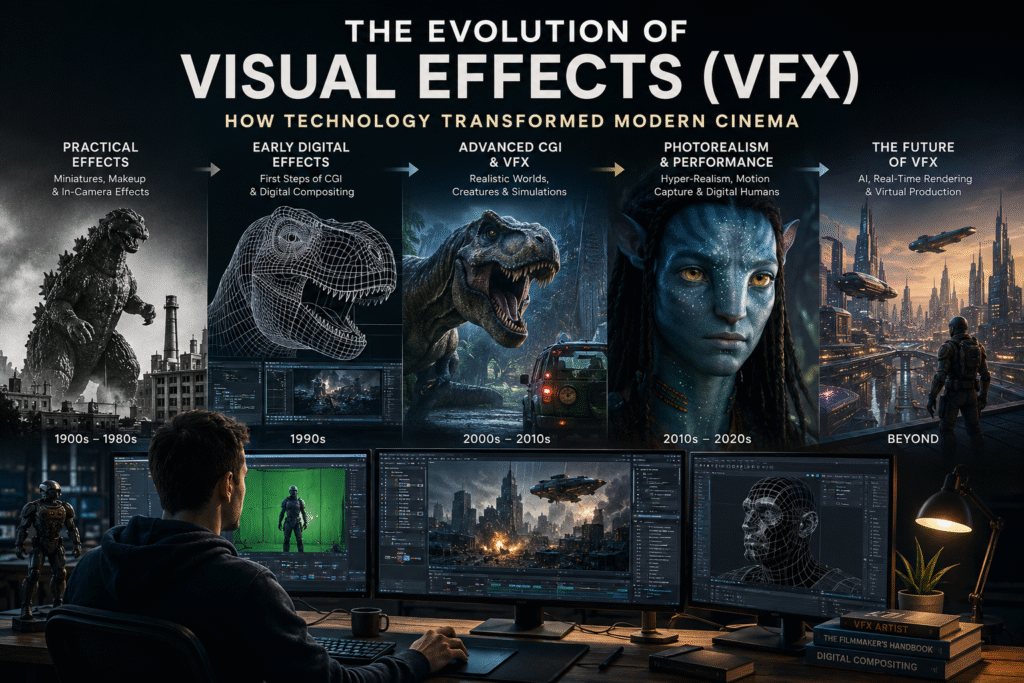
What Are Visual Effects (VFX)?
Visual Effects, commonly known as VFX, refer to the process of creating or manipulating imagery outside of live-action filming to enhance or completely transform scenes in movies and television. Unlike traditional filming techniques, VFX combines computer-generated imagery (CGI), digital compositing, animation, motion tracking, and other advanced technologies to create visuals that would be impossible, dangerous, or too expensive to capture in real life.
VFX artists work during post-production, carefully integrating digital elements with live-action footage so that audiences cannot distinguish between what was filmed and what was created digitally. Whether it’s creating realistic dinosaurs, futuristic spacecraft, magical creatures, or large-scale disasters, VFX helps filmmakers turn imagination into reality while maintaining a believable cinematic experience.
The Early Days of Practical Effects
Before computers revolutionized filmmaking, directors relied heavily on practical effects to create cinematic illusions. Practical effects included miniature models, makeup, prosthetics, animatronics, pyrotechnics, matte paintings, and mechanical rigs that were physically built and filmed during production. These techniques required incredible craftsmanship and creativity, often pushing filmmakers to invent new methods for achieving spectacular visuals.
Classic films demonstrated how practical effects could transport audiences into entirely different worlds long before digital technology existed. Miniature cities, stop-motion animation, and handcrafted monsters amazed viewers and laid the foundation for modern visual storytelling. Although technology has advanced significantly, practical effects remain valuable today because they provide realistic textures and interactions that are sometimes difficult to replicate digitally.
The Rise of Computer-Generated Imagery (CGI)
The introduction of Computer-Generated Imagery (CGI) marked one of the biggest milestones in cinematic history. Instead of relying solely on physical models and practical effects, filmmakers could now create highly detailed digital environments, characters, and action sequences entirely within computers. CGI opened endless creative possibilities and dramatically expanded what could be shown on screen.
As computing power improved, CGI became more realistic, allowing artists to simulate natural elements such as water, fire, weather, and facial expressions with incredible accuracy. Today, CGI is used in nearly every major film, whether audiences notice it or not. From invisible digital enhancements to fully animated characters, CGI has become an essential component of modern filmmaking that supports both fantasy and realism.
How VFX Changed Modern Filmmaking
Visual effects have fundamentally transformed how movies are planned, filmed, and produced. Directors are no longer limited by physical locations, expensive sets, or impossible camera movements. Entire worlds can be designed digitally, allowing filmmakers to tell stories that were once considered impossible to bring to life.
VFX has also improved production efficiency by reducing the need for costly practical builds and dangerous stunts. Green screens, digital doubles, and virtual environments enable actors to perform safely while artists later create realistic backgrounds and effects. Beyond blockbuster action films, VFX is widely used in historical dramas, science fiction, fantasy, superhero films, documentaries, and even romantic comedies for subtle enhancements that audiences rarely notice.
The Difference Between VFX and Special Effects
Although many people use the terms interchangeably, Visual Effects (VFX) and Special Effects (SFX) are different aspects of filmmaking. Special effects refer to physical effects created during production, such as explosions, rain machines, prosthetic makeup, mechanical creatures, and practical stunts. These effects occur on set while the cameras are rolling.
Visual effects, on the other hand, are created after filming during post-production using digital software and computer graphics. VFX artists enhance or replace footage by adding digital elements that seamlessly blend with live-action scenes. In many modern productions, filmmakers combine both practical effects and VFX to achieve the most realistic and visually stunning results.
Motion Capture and Performance Technology
Motion capture, often called MoCap, has revolutionized character animation by recording the movements and facial expressions of actors and transferring them to digital characters. Actors wear specialized suits equipped with sensors while cameras capture every movement in precise detail. The recorded performance is then applied to computer-generated models, creating realistic animations that preserve the actor’s emotions and physical performance.
This technology has become especially important in fantasy, science fiction, and animated films, where digital characters need to display believable human emotions and natural movement. Modern performance capture systems even record subtle facial expressions and eye movements, making digital characters more lifelike than ever before.
The Role of Artificial Intelligence in VFX
Artificial Intelligence is rapidly transforming the visual effects industry by automating repetitive tasks and improving production efficiency. AI-powered tools can assist with rotoscoping, object tracking, facial enhancement, background removal, noise reduction, image upscaling, and scene reconstruction, allowing artists to focus more on creative work.
Machine learning algorithms are also improving animation, facial performance capture, and digital compositing by producing more accurate and realistic results. As AI technology continues to evolve, it is expected to reduce production time while maintaining the high-quality standards required for professional filmmaking. Rather than replacing VFX artists, AI serves as a powerful assistant that enhances creativity and accelerates complex workflows.Visual Effects (VFX)
Challenges of Creating High-Quality Visual Effects
Despite remarkable technological advancements, producing high-quality visual effects remains a challenging and resource-intensive process. Creating realistic CGI requires skilled artists, powerful computer hardware, sophisticated software, and months—or even years—of detailed work. Every frame must be carefully designed, rendered, and integrated into live-action footage to ensure seamless realism.
Studios also face challenges such as tight production schedules, increasing audience expectations, rising budgets, and the need to continuously adopt new technologies. Achieving photorealistic effects while maintaining artistic consistency demands close collaboration between directors, cinematographers, editors, animators, and VFX teams throughout the filmmaking process.
The Future of Visual Effects in Cinema
The future of visual effects promises even greater innovation as emerging technologies continue to reshape filmmaking. Real-time rendering, virtual production, extended reality (XR), cloud computing, and artificial intelligence are making it possible to create complex visual effects faster and more efficiently than ever before. Filmmakers can now preview digital environments during filming, reducing post-production time and improving creative decision-making.
As hardware and software continue to evolve, audiences can expect increasingly immersive cinematic experiences featuring hyper-realistic digital characters, interactive storytelling, and seamless integration between practical filmmaking and computer-generated imagery. Visual effects will remain one of the driving forces behind the evolution of modern cinema, enabling storytellers to push the boundaries of imagination.Visual Effects (VFX)
Conclusion
The evolution of visual effects has transformed cinema from practical illusions to breathtaking digital masterpieces that captivate audiences around the world. Through innovations such as CGI, motion capture, artificial intelligence, and virtual production, VFX has expanded the creative possibilities available to filmmakers while redefining how stories are brought to life on screen.
As technology continues to advance, visual effects will play an even greater role in shaping the future of entertainment. Whether enhancing subtle scenes or creating entirely new worlds, VFX remains an essential part of modern filmmaking, proving that imagination combined with technology has no limits.
Internal Links
- The Magic of Cinematography: How Camera Angles and Lighting Shape Every Movie
- The Art of Film Editing: The Invisible Storyteller
- How AI Is Changing the Future of Filmmaking
- The Power of Movie Soundtracks: How Music Brings Stories to Life
- How Streaming Platforms Changed the Way We Watch Movies
- How Screenwriters Turn Ideas into Blockbuster Movies