
In modern content creation, many beginners believe that professional editing is about using more effects, faster transitions, and complex visuals. They often assume that adding as many creative elements as possible will automatically make a video look cinematic or high quality. However, in professional filmmaking and editing, the opposite is often true. Simplicity is what makes editing feel clean, polished, and impactful.
Great editing is not about showing every effect available in a software—it is about knowing what to remove, what to emphasize, and when to stay subtle. Professional editors understand that the purpose of editing is to support the story, not distract from it. When editing becomes too flashy or overloaded, viewers stop focusing on the content itself and start noticing the editing instead.
To understand this better, imagine watching a motivational video filled with constant zooms, heavy transitions, loud sound effects, and excessive text animations. Even if the message is meaningful, the overwhelming visuals can quickly become distracting and exhausting. Now compare that to a video with smooth cuts, balanced pacing, clean visuals, and carefully chosen music. The second video feels more natural, professional, and emotionally effective—not because it uses more effects, but because it uses only what is necessary.
Simplicity creates clarity. Clean editing allows viewers to focus on the message, emotion, and story without interruption. Every cut feels intentional, every transition serves a purpose, and every visual element contributes to the experience rather than competing for attention.
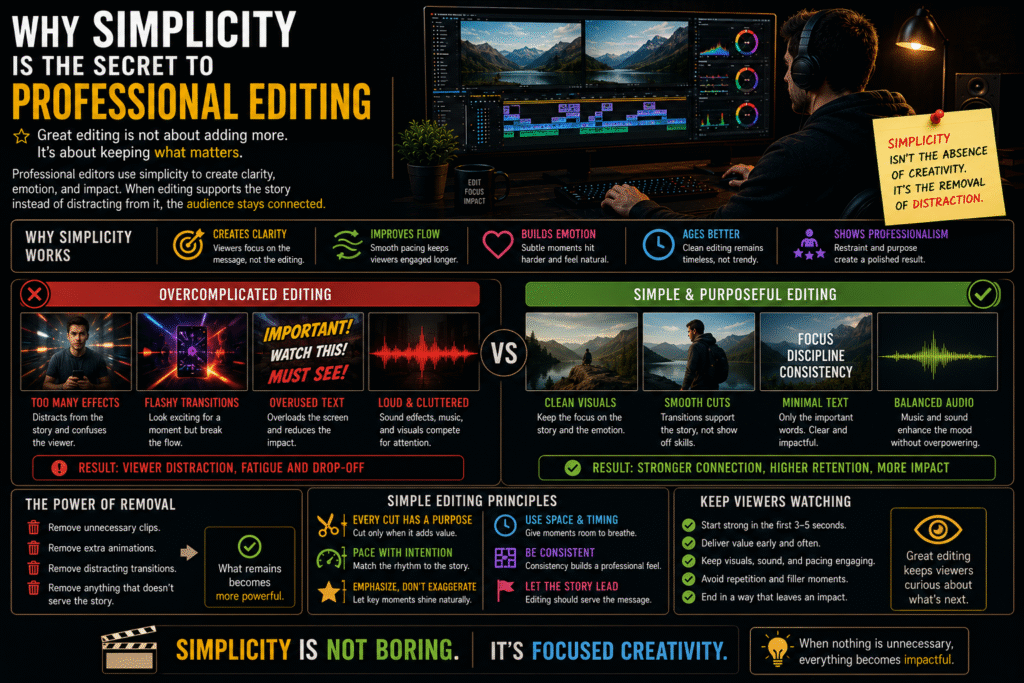
Another important reason simplicity works is because it improves flow. Videos with excessive effects often feel chaotic and inconsistent. In contrast, simple editing creates rhythm and continuity, making the content easier and more enjoyable to watch. This smoothness keeps audiences engaged for longer periods without mental fatigue.
Professional editing also relies heavily on restraint. Knowing when not to use an effect is just as important as knowing when to use one. Editors often remove unnecessary movements, shorten overly long sequences, and simplify transitions to maintain focus and immersion. This restraint is what gives professional content its polished appearance.
Simplicity also helps videos age better over time. Trend-heavy editing styles may feel exciting temporarily, but they often become outdated quickly. Clean and minimal editing, on the other hand, remains timeless because it prioritizes storytelling and viewer experience over temporary visual trends.
In real-world content creation, simplicity is especially important for audience retention. Viewers consume content rapidly, and overly complicated visuals can become distracting rather than engaging. Smooth pacing, clear visuals, readable text, and balanced sound design create a more comfortable viewing experience that encourages audiences to continue watching.
This does not mean editing should feel boring or empty. Simplicity is not the absence of creativity—it is controlled creativity. Professional editors carefully choose moments where effects, transitions, or sound enhancements truly add value. Because these choices are selective, they become more impactful.
Ultimately, simplicity reflects confidence in storytelling. It shows that the creator trusts the message and understands that emotion, pacing, and clarity matter more than constant visual stimulation.
🎯 Conclusion
Professional editing is not defined by how many effects are used, but by how effectively the story is communicated.
Simplicity allows viewers to stay connected to the content without distraction. It creates clarity, improves flow, and makes emotions feel more natural and authentic.
In the end, the best editing is often the editing that feels effortless—where every choice serves the story, and nothing exists without purpose.