
In video editing and storytelling, pacing is one of the most important elements that audiences rarely notice consciously, yet constantly feel throughout the viewing experience. Pacing controls the rhythm, speed, and emotional flow of a video. It determines how quickly information is delivered, how long moments stay on screen, and how naturally scenes transition from one to another. When pacing is strong, videos feel engaging and effortless. When pacing is weak, even good content can feel slow, confusing, or exhausting.
Pacing is often described as the heartbeat of editing because it controls how audiences emotionally move through a story. Fast pacing creates energy, urgency, and excitement, while slower pacing creates emotional depth, tension, and reflection. Great editors understand that pacing is not about making videos fast all the time—it is about controlling rhythm in a way that supports the story and keeps viewers connected.
To understand this better, imagine watching an action sequence with slow cuts, long pauses, and delayed reactions. The scene would immediately lose intensity and excitement. Now imagine an emotional conversation edited with extremely fast cuts and constant movement. Instead of feeling emotional, the scene may feel rushed and disconnected. In both cases, the problem is not the visuals or acting—it is the pacing.
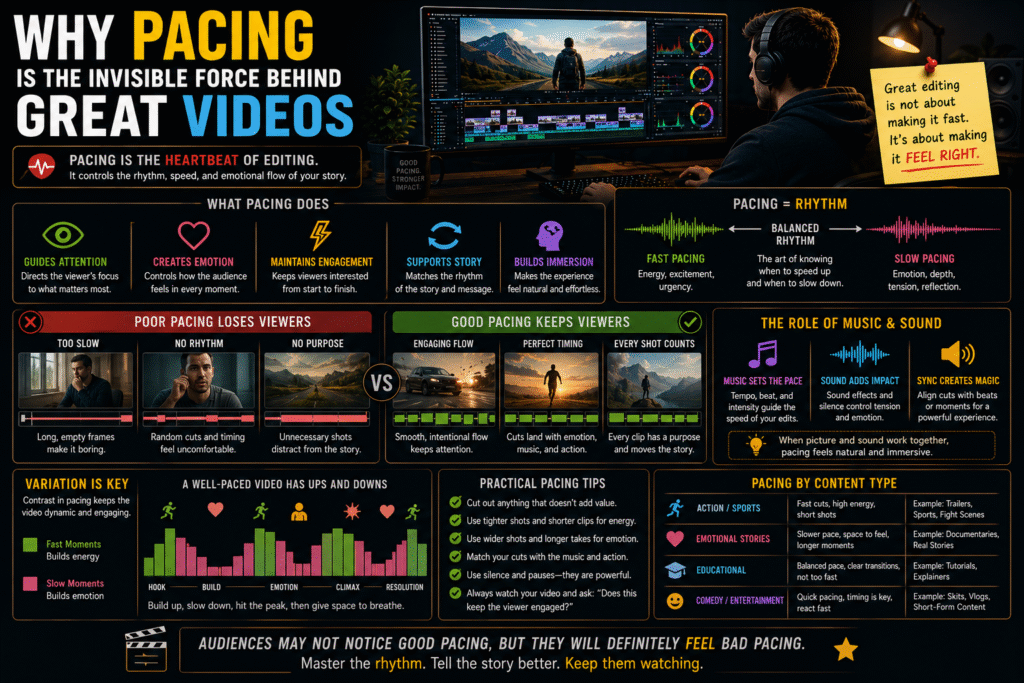
Strong pacing helps maintain audience attention. Modern viewers consume content rapidly, especially on digital platforms where endless videos compete for attention. If a video takes too long to reach its point or contains unnecessary moments, audiences quickly lose interest. Editing removes this friction by tightening scenes, improving rhythm, and ensuring every moment serves a purpose.
Pacing also influences emotional impact. Slowing down a scene slightly can allow viewers to absorb emotion and connect with characters more deeply. Faster pacing can build excitement, suspense, or motivation. By adjusting timing carefully, editors shape how audiences emotionally experience the story without using words.
Another important aspect of pacing is variation. Videos that maintain the exact same rhythm throughout often feel repetitive or monotonous. Great editing uses contrast—moments of speed followed by moments of calm—to create a more dynamic and engaging experience. This balance prevents fatigue and keeps audiences emotionally invested.
Music and sound design also play a major role in pacing. Cuts aligned with musical beats often feel smoother and more satisfying. Background music helps establish rhythm, while silence can create tension and anticipation. Together, visuals and audio create a pacing structure that feels natural and immersive.
In modern content creation, pacing has become even more critical because audience attention spans are shorter than ever. YouTube videos, reels, advertisements, and short-form content all rely heavily on strong pacing to maintain retention. Creators who understand pacing are often more successful at keeping viewers engaged from beginning to end.
However, pacing should never feel forced. One common mistake creators make is over-editing content to make it feel constantly energetic. Excessive speed, constant transitions, and nonstop movement can overwhelm audiences and reduce emotional impact. Effective pacing comes from understanding when to speed up, when to slow down, and when to simply let a moment breathe.
Ultimately, pacing is what makes editing feel alive. It guides audience attention, controls emotion, shapes immersion, and determines how naturally a story unfolds.
🎯 Conclusion
Pacing is not just about speed—it is about rhythm, balance, and emotional timing.
Great pacing keeps viewers engaged without exhausting them. It creates energy where excitement is needed and silence where emotion needs space to breathe.
In the end, audiences may not consciously notice pacing, but they always feel its effect. It is the invisible force that transforms simple footage into an engaging and emotionally powerful experience.