
In filmmaking and content creation, what we see on screen is only the final version of a much larger process. Before a video becomes smooth, engaging, and meaningful, it exists as raw footage—unstructured, repetitive, and often messy. The transformation of this raw material into a compelling story is where editing plays its most important role.
Raw footage rarely resembles the final product. Scenes are shot multiple times, from different angles, and often out of sequence. There are pauses, mistakes, variations in performance, and inconsistencies in lighting or sound. On its own, this footage does not tell a clear story. It is simply a collection of moments waiting to be shaped.
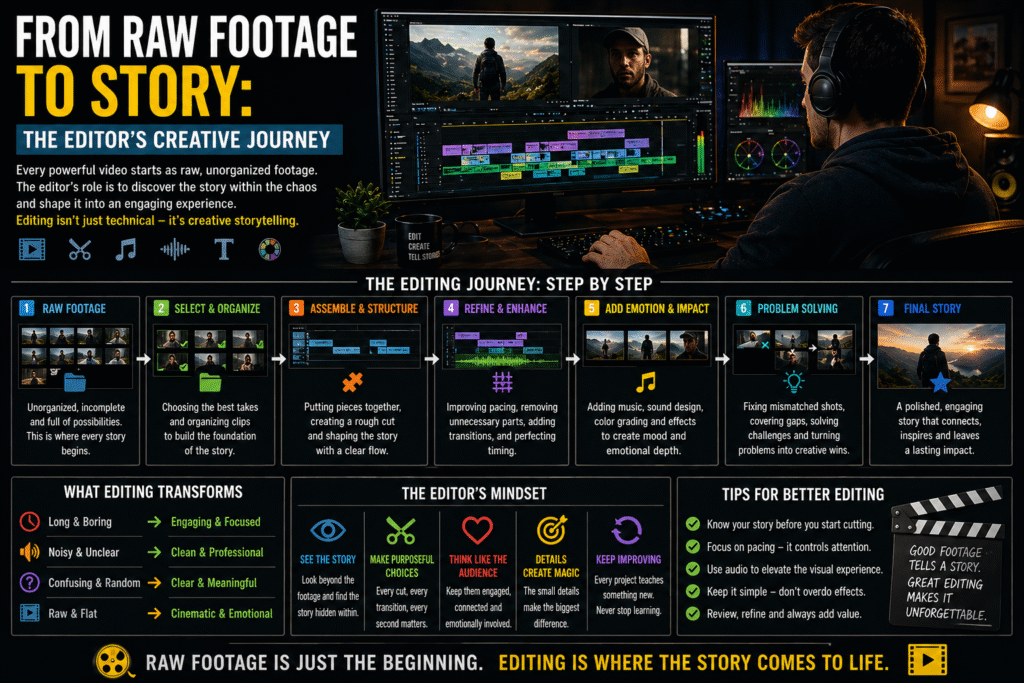
The editor’s job is to bring order to this chaos. This process begins with selecting the best takes—choosing the moments that feel most natural, expressive, and relevant. From there, the editor starts assembling these pieces, building a rough structure that forms the foundation of the story. At this stage, the focus is not perfection, but direction—understanding how the narrative should flow.
As the editing process continues, refinement becomes key. Unnecessary parts are removed, pacing is adjusted, and transitions are smoothed out. The editor carefully decides how long each shot should stay on screen and how one moment should lead into the next. These decisions may seem small, but they significantly impact how the audience experiences the story.
To understand this better, imagine a simple interview video. In its raw form, it may include long pauses, repeated lines, background noise, and off-topic moments. When edited, these distractions are removed, key points are highlighted, and the conversation flows naturally. The result feels clear, professional, and engaging—even though the core content remains the same.
Beyond structure and pacing, editing also adds emotional depth. Through the use of music, sound design, and visual rhythm, the editor enhances the mood of the video. A slow, thoughtful sequence can create emotion, while faster cuts can bring energy and excitement. This layering of elements transforms the video from basic footage into a complete experience.
Another important part of the editor’s journey is problem-solving. Not all footage is perfect. Sometimes shots don’t match, performances vary, or important moments are missing. Editors often find creative ways to overcome these challenges—using cutaways, rearranging scenes, or adjusting timing to maintain continuity and flow. In many cases, editing doesn’t just improve the story—it saves it.
In today’s content-driven world, this process is not limited to films. Whether it’s a YouTube video, an advertisement, or a short-form reel, the journey from raw footage to finished content follows the same principles. The difference between average and high-quality content often lies in how effectively this transformation is handled.
Ultimately, editing is not just about assembling clips—it is about discovering the story hidden within the footage. It requires creativity, patience, and a deep understanding of how visuals, sound, and timing work together.
In the end, what the audience sees is not just what was filmed—it is what was carefully chosen, shaped, and refined. That is the true journey of editing.