
When people think about videos or films, they usually focus on what they see—visuals, camera quality, and scenes. However, what truly shapes the emotional depth of a story is often something less visible but equally powerful—sound design.
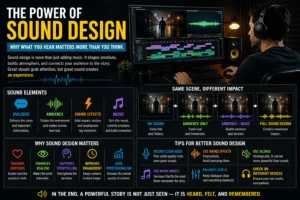
Sound design is not just about adding background music. It includes dialogue clarity, ambient sounds, sound effects, silence, and audio transitions. Together, these elements create an immersive experience that makes a scene feel real and emotionally engaging. Without sound, even the most visually stunning scenes can feel empty and lifeless.
To understand this better, imagine watching a scene where a character is walking alone at night.
- With no sound → the scene feels flat and unnatural
- With soft footsteps, distant wind, and subtle background music → the scene feels immersive and slightly tense
- Add sudden sharp sound effects → the same scene becomes suspenseful and intense
The visuals remain unchanged, but the entire experience shifts because of sound.
Sound design plays a critical role in guiding audience emotions. Soft music can make a scene feel emotional, while intense background scores can create tension and excitement. Even silence can be powerful. A sudden drop in sound before a dramatic moment builds anticipation and makes the impact stronger.
Timing in sound is just as important as timing in visuals. The placement of a sound effect or music cue can completely change how a moment is perceived. A perfectly timed sound can enhance a scene, while poor audio timing can weaken it.
In real-world content, sound design is often what separates amateur videos from professional ones. Many beginners focus heavily on visuals but ignore audio quality. As a result, their content may look good but feels incomplete.
Consider YouTube videos or social media content:
- 🎧 Clean audio → professional feel
- 🎵 Background music → emotional connection
- 🔊 Sound effects → engagement and clarity
Even simple edits like adding subtle music or improving voice clarity can significantly elevate content quality.
Sound also helps maintain realism. Ambient sounds like traffic noise, room tone, or environmental effects make scenes believable. Without these details, videos can feel artificial and disconnected from reality.
At the same time, sound must be balanced. Overuse of effects or loud music can overwhelm the audience, while too little sound can make content feel dull. The goal is to enhance the story without distracting from it.
Sound is often the most underestimated element in video creation. While visuals immediately grab attention, it is sound that quietly builds atmosphere, shapes emotion, and makes a story feel real. A viewer might forgive average visuals, but poor audio instantly breaks immersion. That’s because our brains are highly sensitive to sound—it tells us where we are, what’s happening, and how we should feel.
Sound design goes far beyond just adding background music. It is a carefully crafted combination of dialogue, ambient noise, sound effects, and silence. Each layer plays a specific role. Dialogue delivers information, ambient sound creates environment, effects add realism, and music guides emotion. When these elements are balanced correctly, the audience doesn’t just watch the story—they experience it.
🎯 Conclusion
Sound design is one of the most underrated yet powerful elements in storytelling. While visuals capture attention, sound creates emotion, depth, and immersion.
A great video is not just something you watch—it’s something you experience. And that experience is shaped as much by what you hear as by what you see.
In the end, strong visuals may attract viewers, but powerful sound design is what keeps them connected.